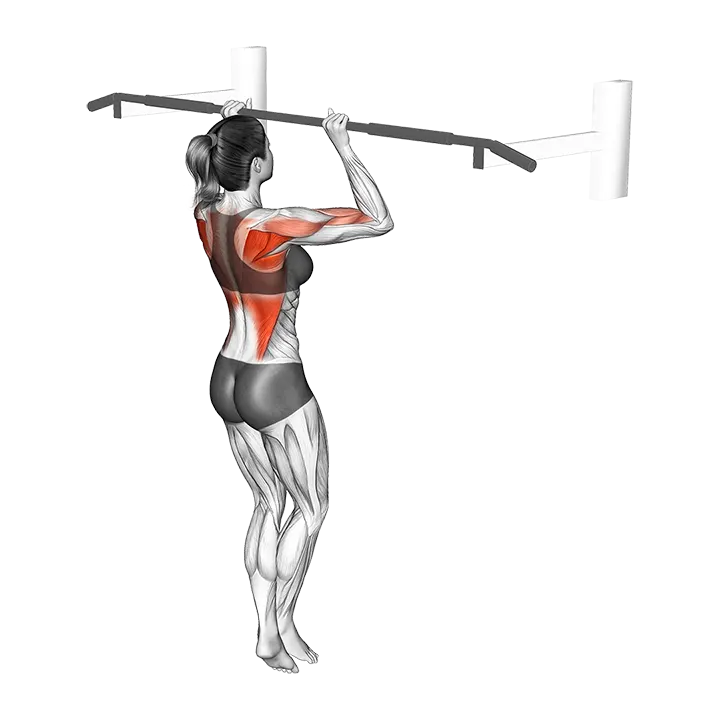
Top Pull-up Hold
- Zielmuskel
- —
- Equipment
- Body weight
- Körperregion
- Back
- Typ
- Strength
The Top Pull-up Hold is an isometric bodyweight exercise that challenges your back muscles at the strongest point of the pull-up movement, with your chin above the bar and elbows fully bent. Holding this contracted position for time builds static pulling strength and end-range muscle endurance that transfers directly to regular pull-ups and other pulling exercises.
Top Pull-up Hold: So führst du sie aus
- 1Grip the pull-up bar slightly wider than shoulder-width with an overhand grip, wrapping your thumbs fully around the bar.
- 2Jump or step up to reach the top of the pull-up position so your chin clears the bar and your chest is close to it.
- 3Once in position, pull your shoulder blades down and together to fully engage your back muscles.
- 4Hold with your elbows completely bent, chin above the bar, and body as still as possible — no swinging or kipping.
- 5Breathe in a controlled, shallow rhythm throughout the hold; do not hold your breath.
- 6Maintain the position for the target duration, keeping your chin above the bar the entire time.
- 7Lower yourself under control at the end of the hold, extending your arms slowly until fully straight before releasing the bar.
Technik-Tipps
- Actively pull your shoulder blades down and back throughout the hold — letting them creep upward shifts tension away from the back and into the upper traps.
- Keep your legs straight or slightly bent and your ankles uncrossed to prevent swinging and maintain full-body tension.
- If you cannot reach the target duration with your chin above the bar, reduce the hold time and build up gradually rather than letting form break down.
- Squeeze your back muscles intentionally rather than relying solely on your arms — this makes the isometric stimulus more effective.
Häufige Fehler
- Letting your chin drop below the bar partway through the hold, which shortens the range of the isometric and reduces the training benefit.
- Shrugging the shoulders upward, which shifts the workload away from the back and places unnecessary stress on the upper traps and neck.
- Using a kip or momentum to get into the top position — this does not reflect true static strength and can strain the shoulders.
- Holding your breath for the entire duration, which raises blood pressure and accelerates fatigue; breathe in a steady, shallow pattern.
- Allowing the elbows to flare wide rather than staying roughly under the bar, which puts undue stress on the shoulder joints.
Häufig gestellte Fragen
What muscles does the Top Pull-up Hold work?
The Top Pull-up Hold places the back muscles under sustained isometric tension at the top of the pull-up movement. The arms and core also engage to stabilize the hold, but the primary demand is on the back.
How long should I hold the top pull-up position?
Beginners can start with 5–10 second holds and build from there. As strength improves, work toward 20–30 seconds per hold. Accumulate several sets of shorter holds rather than grinding through with collapsing form.
Is the Top Pull-up Hold good for beginners?
It can work for beginners who have some pulling ability, but you first need enough strength to reach the top position. Use a box or step to jump into position so you can train the hold without needing to pull up from a dead hang.
How do I get into the top position if I cannot do a full pull-up?
Place a box, bench, or step under the bar and use it to jump or step directly into the contracted top position. This lets you train the isometric hold independently of the pulling phase.
What is the difference between the Top Pull-up Hold and a regular pull-up?
A pull-up is a dynamic exercise moving through the full range of motion. The Top Pull-up Hold isolates the contracted top position as an isometric, building static strength and end-range endurance that complements regular pull-up training.







