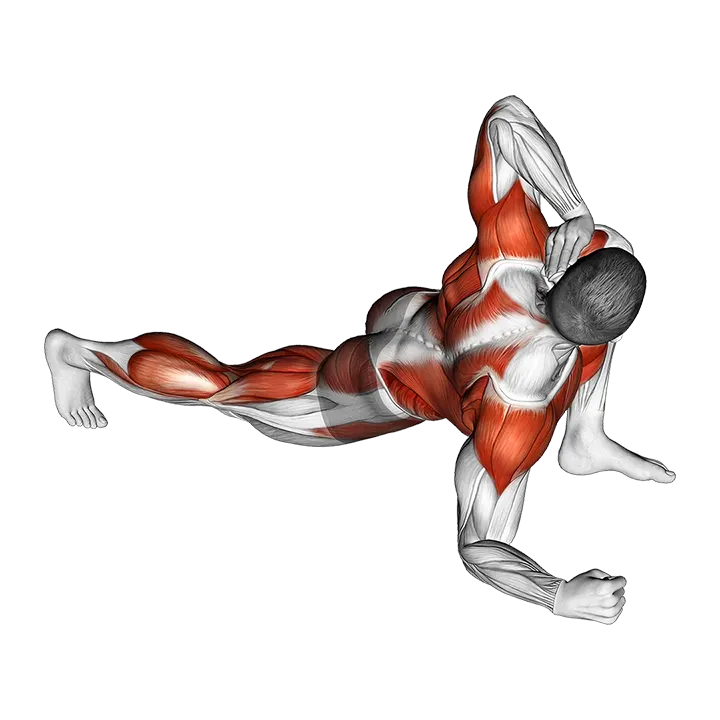
Warming-up in Lunge (seven)
- Zielmuskel
- —
- Equipment
- Body weight
- Körperregion
- Back, Hips, Shoulders, Thighs, Waist
- Typ
- Stretching
Warming-up in Lunge (seven) is a bodyweight mobility sequence that moves through seven linked positions from a forward lunge stance, progressively opening the hips, thighs, waist, back, and shoulders in a single continuous flow. Because it addresses multiple regions at once, it is well suited as a general warm-up before lower-body training, compound lifting, or any athletic activity that demands broad joint mobility.
Warming-up in Lunge (seven): So führst du sie aus
- 1Stand tall with feet hip-width apart. Step your right foot forward into a deep lunge, lowering your left knee toward the floor without letting it slam down.
- 2Place both hands flat on the floor on either side of your right foot to stabilize yourself — this is position one.
- 3Drive your right elbow down toward the inside of your right foot and hold a brief pause to open the hip — position two.
- 4Plant your right hand on the floor and rotate your left arm upward, reaching toward the ceiling to open the thoracic spine — position three.
- 5Return that arm down, then straighten your right leg by pushing your hips back to stretch the right hamstring — position four.
- 6Bend the right knee again to return to lunge depth, then reach both arms straight overhead alongside your ears to lengthen the waist and open the shoulders — position five.
- 7Lower your arms and place both hands back on the floor, then shift your weight slightly forward over the right foot to increase the hip-flexor stretch on the left side — position six.
- 8Rotate your torso to the right and extend the right arm toward the ceiling again for a final thoracic and shoulder opener — position seven.
- 9Return to standing and repeat the entire sequence on the opposite side, stepping the left foot forward.
Technik-Tipps
- Move at a deliberate, unhurried pace through each position — pausing two to three seconds at each station lets the targeted tissue actually release rather than simply passing through range of motion.
- Keep your front knee tracking over your second toe throughout the lunge; caving inward reduces hip stretch and compresses the knee joint.
- When reaching the arm overhead in positions five and seven, elongate through the side of the torso rather than flaring the lower ribs — the goal is length, not lumbar extension.
- Breathe out as you move into each new position and breathe in as you transition; matching breath to movement helps deepen each stretch progressively.
- If your back knee is uncomfortable on the floor during the deeper hip positions, place a folded mat or a small pad beneath it.
Häufige Fehler
- Rushing through the positions: moving too quickly turns a mobility drill into a balance exercise; none of the target tissues receive enough time under stretch to improve range of motion.
- Letting the front heel rise off the floor: losing heel contact shifts load onto the toes, destabilizes the ankle, and reduces the stretch on the calf and hip.
- Allowing the torso to collapse forward on the overhead reach: folding at the waist defeats the purpose of positions five and seven; keep the chest open and the spine long.
- Skipping to the easier positions: athletes often default to the positions that feel comfortable and gloss over the stiff ones, exactly where the mobility work is most needed.
- Performing only one side: treating this as a unilateral drill and skipping the second leg leaves an asymmetry in place rather than resolving it.
Häufig gestellte Fragen
What does the 'seven' mean in Warming-up in Lunge (seven)?
The number refers to the seven distinct positions or checkpoints the movement cycles through from a single lunge stance before you switch legs. Each position targets a different area — hip flexors, hamstrings, thoracic spine, waist, and shoulders — making it a compact multi-joint warm-up.
When should I do this exercise in my workout?
It is designed as a warm-up drill and works best at the start of a session before any loaded lower-body or compound work. Running through two to three rounds per side takes only a few minutes and prepares the hips, spine, and shoulders for heavier movement patterns.
How many times should I repeat the sequence?
Two to three rounds per side is typically sufficient for a general warm-up. If you are particularly stiff or are preparing for a demanding session, a third or fourth round with slightly longer pauses at tight positions can help.
Can beginners do this exercise safely?
Yes, but beginners may find some positions challenging if hip flexor or thoracic mobility is limited. Start with a slightly shorter lunge stride and only go as far into each position as your range of motion comfortably allows — the range will improve over time.
Does this exercise replace a full warm-up?
It covers a broad range of joints and is a strong component of a warm-up, but it works best alongside a few minutes of light cardio to raise core temperature before stretching. Combining both gives the most benefit ahead of a full training session.







