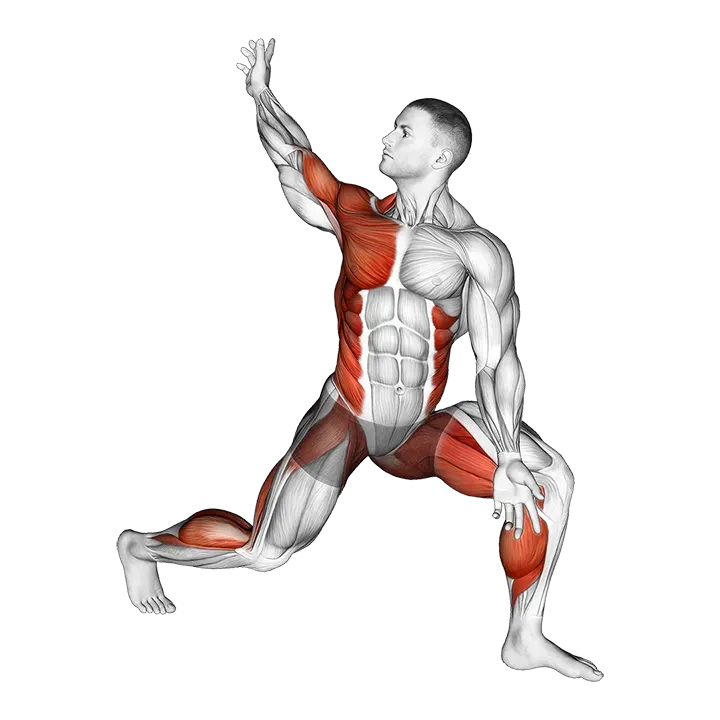
Warming-up in Lunge (three)
- Zielmuskel
- —
- Equipment
- Body weight
- Körperregion
- Chest, Hips, Shoulders, Thighs, Waist
- Typ
- Stretching
Warming-up in Lunge (three) is a dynamic stretching routine performed in a lunge position that mobilises the chest, hips, shoulders, thighs, and waist in a single flowing sequence. By combining a deep lunge with a rotational reach, it improves tissue temperature, joint range of motion, and movement quality across several major areas simultaneously. It is well suited as a general warm-up before lower-body or full-body training sessions.
Warming-up in Lunge (three): So führst du sie aus
- 1Stand tall with feet hip-width apart and your hands relaxed at your sides.
- 2Step your right foot forward into a lunge, lowering your left knee toward the floor so both knees form roughly 90-degree angles.
- 3Place both hands on the floor on the inside of your right foot to stabilise your position.
- 4Lift your right hand off the floor and rotate your torso to the right, reaching your arm up toward the ceiling to open the chest and shoulders.
- 5Hold the rotated position for one to two seconds, feeling the stretch through your chest, shoulder, hip, and waist.
- 6Return your right hand back to the floor alongside your left hand.
- 7Push through your front foot to stand back up to the starting position.
- 8Repeat the sequence on the opposite side by stepping your left foot forward.
- 9Alternate sides for the desired number of repetitions, moving in a controlled, deliberate rhythm throughout.
Technik-Tipps
- Keep your front knee tracking over your second toe throughout the lunge to maintain proper alignment and reduce joint stress.
- Breathe out as you rotate and reach upward; the exhale helps your torso unwind more fully.
- Initiate the rotation from your mid-back rather than just your arm so the chest and waist receive an effective stretch.
- If your back knee is uncomfortable on the floor, hover it an inch above the surface or place a mat under it.
- Move slowly enough that you feel tension in the hip flexor of the rear leg and the chest and shoulder of the reaching arm.
Häufige Fehler
- Allowing the front knee to cave inward — this shifts stress onto the knee joint and reduces the hip stretch; focus on pushing the knee out over the little toe side of the foot.
- Rushing through the rotation without pausing — moving too fast limits the stretch stimulus to the chest and waist and defeats the purpose of a mobilisation warm-up.
- Rounding the upper back during the reach — a hunched thoracic spine blocks chest and shoulder opening; keep the spine long before rotating.
- Letting the hips rise too high out of the lunge — if the hips lift, the hip flexor stretch is lost; keep the rear knee close to the floor throughout.
- Placing the hand on the outside of the front foot rather than the inside — the inside placement gives the torso room to rotate fully and prevents shoulder crowding.
Häufig gestellte Fragen
What does the warming-up in lunge (three) stretch?
The movement mobilises the chest, hips, shoulders, thighs, and waist. The deep lunge opens the hip flexors and thighs of the rear leg, while the rotational reach targets the chest, shoulders, and lateral waist on the side you are rotating toward.
Is this exercise suitable for beginners?
Yes. The movement requires no equipment and can be scaled easily. Beginners who lack hip flexibility can reduce the lunge depth, and those who find the rotation difficult can start by simply looking over the raised shoulder rather than reaching the arm fully overhead.
How many reps should I do?
For a general warm-up, six to ten repetitions per side is typically sufficient to raise tissue temperature and improve range of motion without fatiguing the muscles before your main session.
Can I use this as a cool-down stretch instead of a warm-up?
Yes. Performed slowly and with longer holds of three to five seconds in the rotated position, it works well as a post-session mobility drill for the chest, hips, and waist.
Why does this variation include a rotation compared to a basic lunge stretch?
Adding the thoracic rotation extends the stretch from the lower body into the upper body, making it a more efficient full-body mobilisation drill. It also trains the ability to dissociate upper and lower body rotation, which carries over to sport and daily movement patterns.







