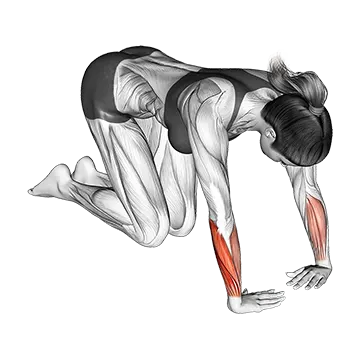
Wrist Circles
- Zielmuskel
- Wrist Extensors, Wrist Flexors
- Equipment
- Body weight
- Körperregion
- Forearms
- Typ
- Strength
Wrist circles are a bodyweight mobility drill that moves the wrist joint through its full rotational range, directly targeting the wrist extensors and wrist flexors of the forearms. They are most commonly used as a warm-up or cool-down movement before and after grip-heavy exercises to improve joint mobility, reduce stiffness, and prepare the forearms for loading.
Wrist Circles: So führst du sie aus
- 1Stand or sit upright and extend both arms in front of you at shoulder height, or rest your elbows on your knees if seated.
- 2Form a loose, relaxed fist with both hands, keeping your fingers curled gently without gripping tightly.
- 3Hold your forearms completely still — all movement should come only from the wrist joint.
- 4Slowly rotate both wrists in a clockwise direction, tracing the largest circle you can through your full range of motion.
- 5Complete the desired number of repetitions clockwise, moving deliberately and without rushing.
- 6Reverse the direction and rotate both wrists counter-clockwise for the same number of repetitions.
- 7Lower your arms and shake out your hands gently to release any residual tension.
Technik-Tipps
- Keep your forearm completely stationary throughout — if your forearm is moving, the wrist is not doing the work.
- Move slowly and deliberately; a controlled rotation engages the wrist extensors and flexors through their full range, while a fast spin shortens effective range of motion.
- Maintain a loose fist rather than a tight grip so the surrounding muscles stay relaxed and the joint can move freely.
- Perform wrist circles both before and after grip-heavy exercises such as deadlifts, pull-ups, or curls to warm up and flush out the forearm muscles.
- Trace the largest circle possible with each rep — small, lazy circles limit the mobility benefit.
Häufige Fehler
- Moving the entire forearm instead of isolating the wrist: this shifts the work away from the wrist joint and defeats the purpose of the drill, reducing both the mobility and warm-up benefit.
- Rushing through repetitions too fast: speed reduces the effective range of motion and prevents the wrist extensors and flexors from being worked through their full arc.
- Skipping the counter-clockwise direction: performing circles in only one direction creates uneven mobility stimulus and can contribute to imbalanced strength and flexibility around the wrist joint.
- Using a tight, clenched fist: a tight grip activates the forearm flexors and limits how freely the wrist joint can move, reducing range of motion.
- Forcing the wrist through pain when stiff: pushing through sharp discomfort rather than working to the edge of comfortable range risks straining the joint capsule or surrounding tendons.
Häufig gestellte Fragen
What muscles do wrist circles work?
Wrist circles primarily target the wrist extensors and wrist flexors, which run along the back and front of the forearms respectively. Because the movement is a mobility drill rather than a loaded strength exercise, the muscles are activated at low intensity through their full rotational range rather than under heavy tension.
When should I do wrist circles — as a warm-up or cool-down?
Both. Performing wrist circles before grip-heavy exercises such as deadlifts, rows, pull-ups, or barbell curls prepares the wrist joint and forearm muscles for loading. Doing them again at the end of a session helps flush out accumulated tension and supports recovery. A round of 10–15 rotations in each direction is sufficient for either purpose.
How many reps and sets of wrist circles should I do?
For a warm-up or cool-down, 10–15 slow rotations clockwise followed by 10–15 counter-clockwise per wrist is a common and effective range. One to two rounds is usually enough before a session; you can do an additional round after. There is no meaningful benefit to high-volume loading for this movement.
Are wrist circles suitable for beginners?
Yes. Wrist circles require no equipment, no prior training experience, and very little coordination. They are one of the safest mobility drills available and are appropriate for all fitness levels, including complete beginners and those returning from periods of inactivity.
What is the difference between wrist circles and wrist rotations?
The terms are often used interchangeably, but wrist circles typically refer to moving the wrist through its full rotational arc (circumduction), tracing a circular path with the fist. Wrist rotations sometimes refer specifically to pronation and supination — rotating the forearm so the palm faces up then down — which is a different movement pattern primarily driven by the forearm rather than the wrist joint itself.