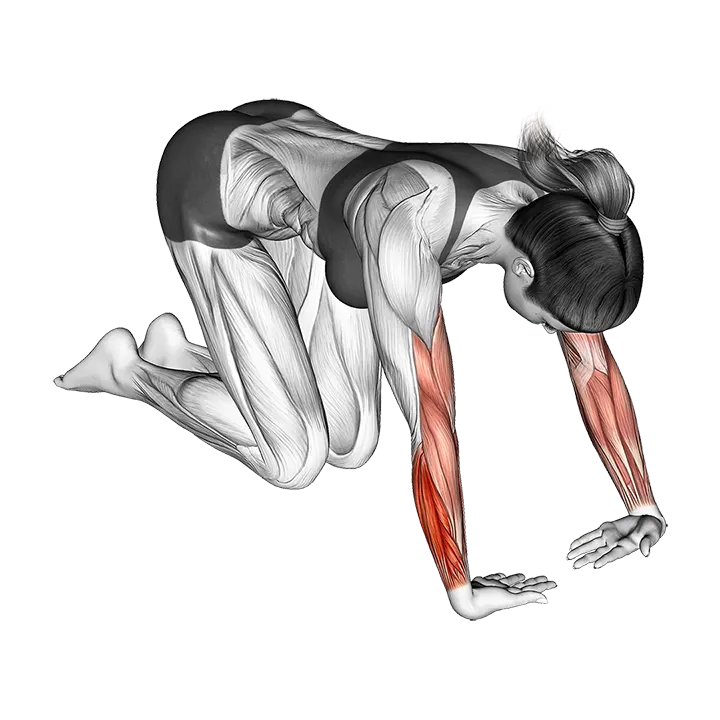
Wrist Radial Deviator And Extensor Stretch
- Zielmuskel
- —
- Equipment
- Body weight
- Körperregion
- Forearms
- Typ
- Stretching
The Wrist Radial Deviator And Extensor Stretch targets the muscles and tendons on the thumb side and back of the forearm — primarily the wrist radial deviators and wrist extensors. By combining wrist flexion with ulnar deviation, the stretch lengthens both muscle groups in a single position. It is useful for reducing tightness from repetitive gripping, typing, or overhead work and for maintaining wrist mobility and joint health.
Wrist Radial Deviator And Extensor Stretch: So führst du sie aus
- 1Stand or sit upright and extend one arm in front of you at roughly shoulder height with your palm facing down.
- 2Make a loose fist or let your fingers point straight down toward the floor.
- 3With your free hand, grasp the back of the outstretched hand around the knuckles.
- 4Gently pull the outstretched hand downward and toward the little-finger side (ulnar deviation), simultaneously guiding the wrist into further flexion.
- 5Stop when you feel a mild tension along the thumb side and back of the forearm — do not push into pain.
- 6Keep the elbow of the stretching arm straight but not forcefully locked.
- 7Breathe slowly and steadily throughout; aim to hold the position for 20–30 seconds.
- 8Release, shake out the wrist gently, then repeat on the opposite side.
- 9Perform 2–3 sets per side.
Technik-Tipps
- Breathe continuously during the hold — slow exhales help the forearm muscles relax into the stretch rather than resist it.
- Aim for mild to moderate tension; you should feel a distinct pull along the back of the forearm and thumb side, but no sharp or shooting pain.
- Hold each stretch for at least 20 seconds — shorter holds do not give the connective tissue enough time to lengthen and adapt.
- Keep your elbow fully extended throughout; a bent elbow shortens the stretch and reduces tension on the wrist extensors.
- Stretch both wrists equally, even if only one side feels tight — asymmetrical forearm flexibility can affect grip strength and overhead mechanics over time.
Häufige Fehler
- Forcing the wrist too far into flexion: applying excessive pressure from the assisting hand overstretches the joint capsule and small wrist ligaments, increasing the risk of irritation or injury.
- Bending the elbow: a flexed elbow slackens the extensor muscles along the forearm, reducing the effectiveness of the stretch on the wrist extensors.
- Holding the breath: breath-holding increases muscle tension throughout the body, making it harder for the forearm muscles to relax and limiting how far you can safely stretch.
- Bouncing or pulsing instead of holding: repeated quick pulls place ballistic load on the tendons and joint structures, which can cause micro-tears rather than the gradual elongation a sustained static hold provides.
- Omitting the ulnar deviation component: pulling the hand straight into flexion without also guiding it toward the little finger misses the radial deviator portion and leaves that part of the intended stretch incomplete.
Häufig gestellte Fragen
What muscles does this stretch target?
It primarily addresses the wrist radial deviators — muscles that bend the wrist toward the thumb side — and the wrist extensors, which run along the back of the forearm. Both groups are heavily recruited during gripping, typing, and racquet or throwing sports.
When is the best time to perform this stretch?
It is most effective as part of a cool-down after training or at the end of a workday, when the forearm muscles are already warm and more receptive to lengthening. You can also use it as a brief mobility reset during prolonged typing or repetitive hand work.
How long and how often should I hold the stretch?
Hold each side for 20–30 seconds and perform 2–3 sets. Stretching 5–7 days per week is appropriate for general maintenance, or daily if you are managing chronic forearm tightness or recovering from repetitive strain.
Can this stretch help with wrist or forearm pain?
Gentle stretching of the radial deviators and wrist extensors can relieve the tightness that contributes to conditions such as lateral epicondylitis (tennis elbow) or repetitive strain discomfort. If you experience sharp, radiating, or persistent pain during or after the stretch, consult a healthcare professional before continuing.







