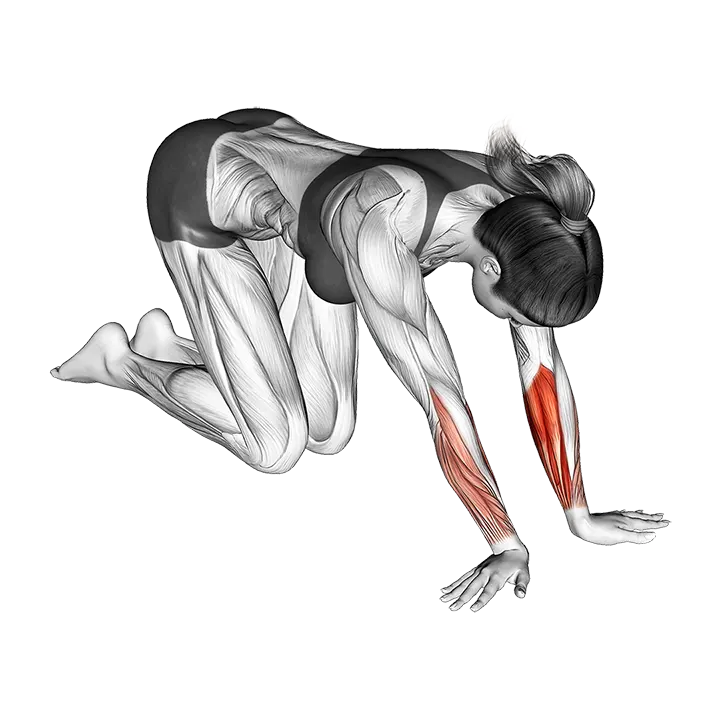
Wrist Radial Deviator And Flexor Stretch
- Zielmuskel
- —
- Equipment
- Body weight
- Körperregion
- Forearms
- Typ
- Stretching
The Wrist Radial Deviator And Flexor Stretch is a bodyweight forearm stretch that targets the radial deviator muscles (which move the wrist toward the thumb side) and the wrist flexors along the inner forearm. Performed with the assistance of the opposite hand, it improves wrist mobility, relieves tightness from repetitive gripping and typing, and helps prevent overuse injuries in the forearm.
Wrist Radial Deviator And Flexor Stretch: So führst du sie aus
- 1Stand or sit upright with your working arm extended in front of you at roughly chest height, elbow straight.
- 2Rotate your forearm so your palm faces downward (pronated position) and allow your wrist to relax.
- 3With your free hand, grasp the back of the working hand from above, fingers curling over the knuckles.
- 4Gently use your free hand to bend the working wrist downward (into flexion) and simultaneously press it toward the little-finger side (ulnar deviation), moving it away from the thumb.
- 5You should feel a stretch along the thumb side and the inner forearm of the working arm — this is the radial deviators and wrist flexors under tension.
- 6Hold the stretched position for 20–30 seconds, breathing slowly and letting the muscles relax into the stretch.
- 7Release the pressure gradually, return the wrist to neutral, and shake the hand out gently.
- 8Repeat on the opposite side, then perform 2–3 rounds per wrist as needed.
Technik-Tipps
- Keep the elbow of the working arm fully extended throughout — bending the elbow reduces tension on the forearm muscles and diminishes the stretch.
- Apply pressure with the assisting hand gradually and smoothly; avoid forcing the wrist into a painful range — aim for a firm pulling sensation, not pain.
- Breathe steadily and exhale as you deepen the stretch; holding your breath causes the forearm muscles to tense up and shortens the effective range.
- Keep your shoulder relaxed and down — shrugging the shoulder during the stretch shifts tension away from the forearm and into the neck.
- For a stronger radial deviator stretch, add a slight wrist extension (bend slightly toward the back of the hand) before applying the ulnar deviation pressure.
Häufige Fehler
- Bending the elbow: a bent elbow shortens the forearm muscle chain and significantly reduces the stretch on the radial deviators and flexors — keep the arm straight.
- Using too much force too quickly: yanking the wrist into position can strain the joint capsule and ligaments; ease into the stretch and let tension build progressively.
- Neglecting the ulnar deviation component: simply bending the wrist down without also pressing it toward the little-finger side misses the radial deviator stretch and only targets the flexors.
- Holding the stretch too briefly: spending fewer than 15–20 seconds in the stretched position is insufficient for the fascia and muscle tissue to release — aim for at least 20–30 seconds.
- Performing the stretch on a stiff, cold forearm: jumping into this stretch without a brief warm-up (light wrist circles or a minute of low-intensity activity) increases discomfort and reduces effectiveness.
Häufig gestellte Fragen
What muscles does the Wrist Radial Deviator And Flexor Stretch target?
This stretch primarily targets the wrist radial deviators — muscles such as the flexor carpi radialis and extensor carpi radialis longus and brevis that pull the wrist toward the thumb side — along with the wrist flexors that run along the inner (palm side) forearm. Together these muscles are heavily used in typing, gripping, and racket or club sports.
When should I perform this stretch?
It works well both as part of a warm-up (with lighter, shorter holds of 10–15 seconds) and as a cool-down stretch after activities that load the forearms, such as weightlifting, rock climbing, tennis, or prolonged keyboard use. It can also be performed throughout the day as a desk-break stretch to relieve forearm tightness.
Can this stretch help with wrist pain or carpal tunnel symptoms?
Regular forearm and wrist stretching can reduce muscular tightness that contributes to wrist discomfort, and it is commonly recommended as part of conservative management for repetitive strain injuries. However, if you have been diagnosed with carpal tunnel syndrome, tendinitis, or another wrist condition, consult a physiotherapist before adding this stretch to ensure it is appropriate for your specific situation.
How often should I do the Wrist Radial Deviator And Flexor Stretch?
For general mobility maintenance, 2–3 sessions per day of 2–3 sets (20–30 second holds each side) is a reasonable starting point. Athletes in forearm-dominant sports or people who type extensively may benefit from more frequent sessions. Consistency matters more than any single long session — short daily stretching produces better long-term gains than infrequent extended sessions.
Is this stretch safe if I have a wrist injury or recent sprain?
Avoid this stretch immediately after an acute wrist sprain or fracture, as applying manual pressure to a recently injured joint can aggravate inflammation and delay healing. Once the acute phase has passed and your healthcare provider has cleared you for gentle mobility work, start with very light pressure and a small range of motion, gradually increasing as tolerance improves.







