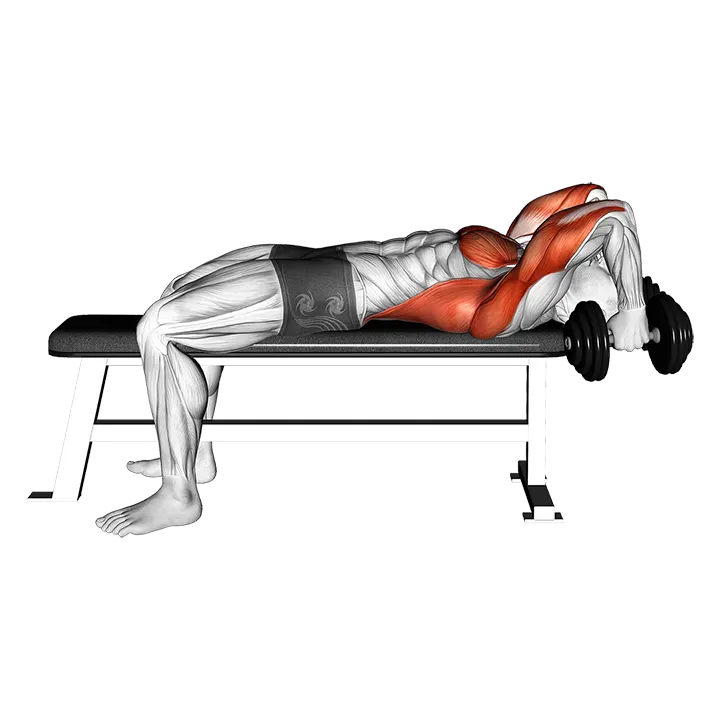
Dumbbell Bent Arm Pullover Hold Isometric
- Equipamiento
- Dumbbell
- Parte del cuerpo
- Chest
- Tipo
- Stretching
The dumbbell bent arm pullover hold isometric is a static stretching hold that loads the lats (latissimus dorsi) and lower chest (pectoralis major, sternal head) along with the teres major and triceps. Lying on a bench, you hold a single dumbbell with bent arms back over and behind your head, building stretch tolerance and mid-rib bracing without moving the weight.
Cómo hacer el Dumbbell Bent Arm Pullover Hold Isometric
- 1Lie flat on a bench with your head supported and your feet planted firmly on the floor. Pull your shoulder blades down and keep your ribs from flaring.
- 2Hold a single dumbbell against your chest, gripping the top end with both hands so your palms cup the inside of the upper plate.
- 3Press the dumbbell up until it sits over your upper chest, then bend your elbows to roughly 90° and keep them tracking close to your head.
- 4Lower the bent-arm dumbbell back and behind your head until you feel a firm stretch across your lats and lower chest.
- 5Stop at the point of a strong but controlled stretch, keeping your elbows soft and bent rather than locking them out.
- 6Brace your core, breathe steadily, and hold this position statically for your target time without letting the weight drift lower.
- 7When the hold is complete, draw the dumbbell back over your chest, sit up under control, and set it down safely.
Consejos de técnica
- Keep your elbows fixed at the same bent angle for the entire hold — the stretch should come from your shoulders, not from your arms straightening.
- Maintain steady, even breathing throughout the hold instead of holding your breath, so your ribs stay down and your brace stays intact.
- Start with a light dumbbell and a shorter hold, then build time and load only once you can keep the stretch position controlled.
- Keep your lower back gently flat against the bench so the work stays in your lats and chest rather than your spine.
Errores comunes
- Letting the dumbbell sink too far behind your head, which over-stretches the shoulder joint and can strain the front of the shoulder.
- Straightening the arms during the hold, which turns it into a different movement and loads the shoulder more aggressively.
- Arching the lower back and letting the ribs flare, which shifts tension off the lats and onto the spine.
- Using too heavy a dumbbell too soon, making the stretch position impossible to control safely.
Preguntas frecuentes
What muscles does the dumbbell bent arm pullover hold isometric work?
It targets the lats (latissimus dorsi) and lower chest (pectoralis major, sternal head), with the teres major and triceps also loaded as you hold the stretched position.
How long should I hold the isometric position?
Beginners can start with 15–20 second holds for 2–3 sets and build toward 30–45 seconds as control improves. Stop the hold if you lose the bent-arm position or feel pain.
Is the bent arm pullover hold good for beginners?
Yes, with a light dumbbell. The static hold is easier to control than a moving pullover and builds stretch tolerance, but keep the load light and the range conservative at first.
Where should I feel this stretch?
You should feel a firm stretch across your lats and lower chest, with some tension in the teres major and triceps. Sharp pain in the front of the shoulder means you have gone too far back.