
Exercise Ball One Leg Prone Lower Body Rotation
- Músculo objetivo
- Gluteus Medius
- Músculos sinergistas
- Quadriceps, Tensor Fasciae Latae, Triceps Brachii
- Equipamiento
- Stability ball
- Parte del cuerpo
- Hips
- Tipo
- Strength


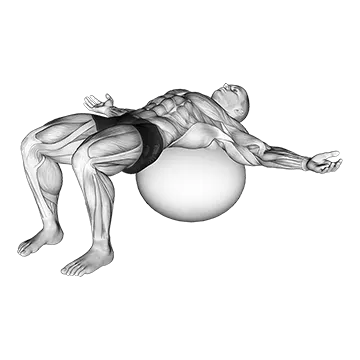

The exercise ball one leg prone lower body rotation is a hip-focused strength and stability move that primarily targets the gluteus medius, with the quadriceps, tensor fasciae latae, and triceps brachii assisting. Held in a plank-style prone position with one shin resting on a stability ball, you rotate your lower body side to side, training the hips to control rotation while your arms stabilize. It's a strong choice for building single-leg hip stability and anti-rotation control.
Cómo hacer el Exercise Ball One Leg Prone Lower Body Rotation
- 1Set up in a plank position with your hands under your shoulders, arms fully extended, and your body in a straight line from head to heels.
- 2Place one shin and the top of that foot on the stability ball, keeping the other leg lifted or lightly supporting alongside it.
- 3Brace your core and squeeze your glutes so your hips stay level and your spine stays neutral.
- 4Press firmly through your hands and shoulders to lock your upper body in place as your stable base.
- 5Slowly rotate your hips and the supported leg to one side, rolling the ball under your shin while keeping your shoulders square.
- 6Pause briefly at the end of the range, feeling the outer hip of the working leg engage.
- 7Reverse the motion under control and rotate to the opposite side without letting your hips sag.
- 8Continue alternating for your target reps, then lower the leg and step off the ball with control.
- 9Repeat the set with the other leg on the ball.
Consejos de técnica
- Move slowly from the hips rather than swinging the ball with momentum, so the gluteus medius does the work.
- Keep your shoulders stacked over your hands and your elbows soft but firm to give your hips a solid anchor.
- Maintain a straight line from head to heels throughout; think about pulling your belly button toward your spine.
- Start near a wall or with a partner spotting the ball until you trust your balance on the unstable surface.
- Exhale as you rotate away and inhale as you return to center to keep your bracing consistent.
Errores comunes
- Letting the hips sag toward the floor, which loads the lower back and takes tension off the glutes.
- Rushing the rotation and using momentum, so the ball rolls freely instead of the hip muscles controlling it.
- Twisting through the shoulders instead of the hips, which turns it into an upper-body move and reduces the glute medius work.
- Holding your breath, which weakens your brace and makes your trunk less stable on the ball.
- Setting the ball too far down the leg toward the ankle, which makes it wobble unpredictably and harder to control.
Preguntas frecuentes
What muscles does the exercise ball one leg prone lower body rotation work?
It primarily works the gluteus medius (the outer hip), with the quadriceps, tensor fasciae latae, and triceps brachii assisting as you stabilize the position and rotate.
Where should I feel this exercise?
You should feel it mainly in the outer hip of the leg on the ball as it controls the rotation, plus your shoulders and triceps working to hold the plank base steady.
Is this exercise good for beginners?
It's an intermediate move because of the balance demand. Beginners should first be comfortable holding a stable plank, then start with a small range of rotation near a wall before progressing.
How many sets and reps should I do?
Aim for 2-3 sets of 8-12 controlled rotations per side. Prioritize slow, balanced reps over speed, since the goal is hip control and stability.
What's a good alternative if I don't have a stability ball?
Side-lying hip abductions or standing cable hip abductions also target the gluteus medius, though they don't train the same anti-rotation and balance demand as the prone ball version.