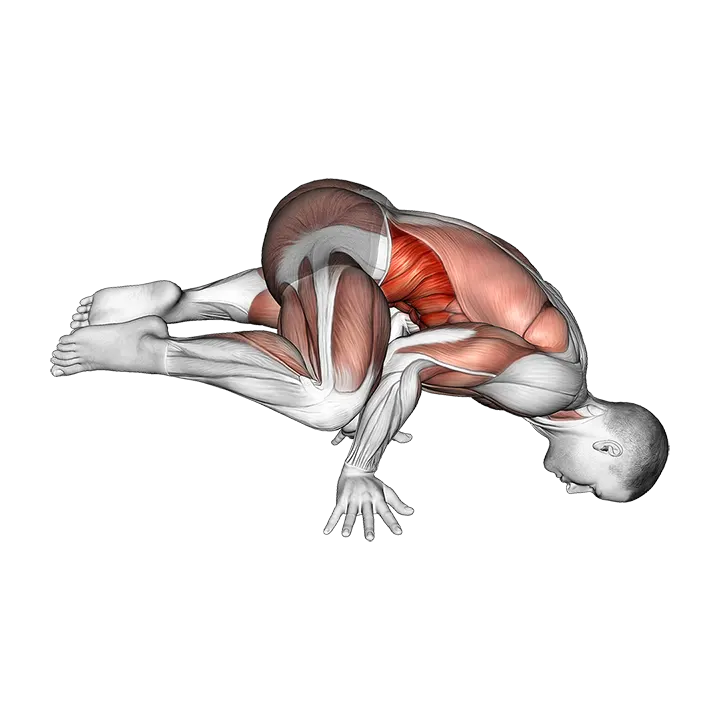
Frog planche
- Músculo objetivo
- Obliques, Rectus Abdominis
- Músculos sinergistas
- Biceps Brachii, Brachialis, Brachioradialis, Gastrocnemius, Gluteus Maximus, Gluteus Medius, Hamstrings, Latissimus Dorsi, Pectoralis Major Clavicular Head, Pectoralis Major Sternal Head, Quadriceps, Soleus, Tensor Fasciae Latae, Teres Major, Triceps Brac
- Equipamiento
- Body weight
- Parte del cuerpo
- Waist
- Tipo
- Stretching
The frog planche, also known as the frog stand, is a bodyweight balance hold that builds core control by working the obliques and rectus abdominis (your abs). You balance on your hands with your knees resting against your elbows, while the chest, biceps, triceps, and lats keep you stable. It's a foundational skill for hand-balancing and a strong test of core and wrist strength.
Cómo hacer el Frog planche
- 1Squat down and place both hands flat on the floor, slightly wider than shoulder-width, with your fingers spread and pointing forward.
- 2Bend your elbows to about 90° and turn them out slightly so the backs of your upper arms create a shelf for your knees.
- 3Lean forward and set the inside of each knee onto the corresponding elbow or upper arm.
- 4Shift your weight forward over your hands, gripping the floor with your fingertips to control balance.
- 5Lift one foot, then the other, off the ground until your full bodyweight is supported on your hands.
- 6Brace your abs and squeeze your obliques, keeping your gaze just ahead of your hands to stay balanced.
- 7Hold the position with steady breathing for your target time, keeping micro-adjustments small.
- 8Lower your feet back to the floor under control and stand up to finish.
Consejos de técnica
- Grip and claw the floor with your fingertips to make constant small balance corrections, rather than relying only on your palms.
- Look slightly forward of your hands instead of straight down — this shifts your weight forward and makes balancing easier.
- Brace your core as if expecting a light punch to the stomach so the obliques and abs hold your hips stable.
- Practice over a folded towel or cushion at first so a fall forward lands softly and you can build confidence.
- Warm up your wrists thoroughly before holding, since they bear most of your bodyweight in this position.
Errores comunes
- Keeping your weight back over your wrists, which makes it impossible to lift the feet and overloads the wrist joint.
- Looking straight down at the floor, which pulls your weight backward and causes you to tip back onto your feet.
- Letting the core go slack, so the hips sag and you lose the stable, compact shape the hold depends on.
- Setting the knees too low on the forearms instead of on the elbows, which gives an unstable shelf and strains the wrists.
- Holding your breath, which raises tension and makes the fine balance corrections harder to control.
Preguntas frecuentes
What muscles does the frog planche work?
It primarily works the core — the obliques and rectus abdominis (abs). The chest, biceps, triceps, lats, and even the legs and glutes act as synergists to hold your body in a stable, balanced shape.
Is the frog planche good for beginners?
Yes. The frog stand is one of the most accessible hand-balancing holds and a common first step toward the crow pose and full planche. Start with short holds and a cushion in front of you for safety.
How long should I hold the frog planche?
Begin with holds of 5–10 seconds and gradually build toward 30–60 seconds as your balance and wrist strength improve. Quality and control matter more than total time.
Why do I keep falling backward onto my feet?
You are likely keeping your weight too far back and looking straight down. Shift your weight forward over your hands and fix your gaze slightly ahead of them to stay balanced.
What's a good progression from the frog planche?
Once you can hold it comfortably, work toward the crow pose (knees higher on the arms) and then tuck planche variations, which demand more straight-arm strength.