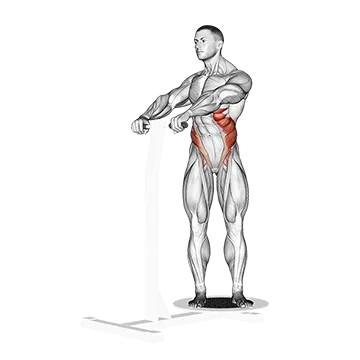
Lever Seated Twist
- Músculo objetivo
- Obliques
- Equipamiento
- Leverage machine
- Parte del cuerpo
- Waist
- Tipo
- Strength
The Lever Seated Twist is a leverage machine exercise that isolates the obliques through a controlled rotational movement. It builds rotational strength and control in the trunk, which carries over to twisting and bracing demands in other lifts and in sport. The fixed machine path keeps tension on the obliques throughout the full range of motion.
Cómo hacer el Lever Seated Twist
- 1Sit upright on the leverage machine seat and adjust the pad so it rests across your upper chest or shoulders.
- 2Plant your feet flat on the footrests or floor, hip-width apart, and keep your hips facing forward.
- 3Grip the handles or pad lightly — use your core, not your arms, to drive the movement.
- 4Brace your core and exhale as you rotate your torso to one side as far as your range of motion comfortably allows.
- 5Hold the peak contraction for one second, feeling the obliques squeeze.
- 6Inhale as you slowly return to the center starting position under control.
- 7Rotate to the opposite side with the same controlled tempo, then return to center again.
- 8Continue alternating until you have completed the prescribed repetitions on each side, then return to center and let the weight stack settle before releasing the handles.
Consejos de técnica
- Set the seat height and pad before loading the machine so the pad sits flat across your chest, not against your throat or lower ribs.
- Keep your hips pressed firmly into the seat throughout the movement — rotation should come from the waist, not the hips.
- Let your head and eyes follow your torso so your neck stays in line with your spine instead of twisting on its own.
- Stop each rotation at the end of your comfortable range rather than forcing the last few degrees; the obliques do not need extra range to work hard.
- Keep your spine tall and avoid rounding your lower back or leaning forward as you rotate.
Errores comunes
- Rotating the hips along with the torso, which shifts the work away from the obliques and reduces the rotational stimulus the exercise is designed to provide.
- Using momentum to swing through the range of motion, which cuts time under tension on the obliques and increases the risk of a lower back strain.
- Pulling with the arms instead of rotating the torso, which transfers load to the shoulders and arms rather than the obliques.
- Using excessive weight before mastering the movement pattern, which encourages compensatory movements, shortens the range of motion, and places unnecessary stress on the lumbar spine.
- Holding the breath throughout the set, which raises intra-abdominal pressure and can cause dizziness; breathing with the rep also helps you control the tempo.
Preguntas frecuentes
What muscles does the Lever Seated Twist work?
The Lever Seated Twist primarily targets the obliques — the muscles that run along the sides of your abdomen. They are responsible for trunk rotation and lateral flexion, so this exercise is a direct way to train rotational core strength.
How many sets and reps should I do for the Lever Seated Twist?
For core strength and endurance, 3–4 sets of 12–20 repetitions per side is a common starting point. Because the obliques respond well to higher rep ranges, keep the weight moderate and prioritize a full, controlled range of motion over heavy loading.
Is the Lever Seated Twist safe for people with lower back issues?
The machine-guided path can be gentler on the lower back than free-weight rotational exercises because it controls the movement arc. However, if you have an existing back condition, consult a medical professional before performing any rotational core exercise and start with very light resistance.
How is the Lever Seated Twist different from a cable woodchop or Russian twist?
Unlike cable woodchops or Russian twists, the leverage machine keeps your torso in a fixed upright path and isolates rotation more strictly. This can make it easier for beginners to learn the movement pattern and for anyone who wants to reduce spinal loading compared to free-weight rotational exercises.
Should I feel the Lever Seated Twist in my lower back?
No. If you feel discomfort in your lower back, you are likely rounding the spine, rotating your hips, or using too much weight. Reduce the load, sit tall, keep your hips still, initiate the twist from the waist, and stop the set if pain persists.