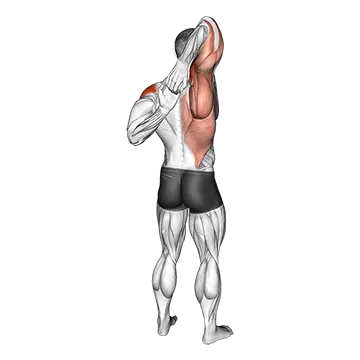
Lying Rear Lateral Raise
- Músculo objetivo
- Deltoid Posterior
- Músculos sinergistas
- Infraspinatus, Teres Minor, Trapezius Lower Fibers, Trapezius Middle Fibers
- Equipamiento
- Body weight
- Parte del cuerpo
- Shoulders
- Tipo
- Strength
The lying rear lateral raise is a body-weight shoulder exercise that isolates the posterior deltoid by raising your arms out to the side while lying face-down. The infraspinatus, teres minor, and both the middle and lower trapezius fibers assist the movement, making it a useful drill for rear delt development and shoulder health without any equipment.
Cómo hacer el Lying Rear Lateral Raise
- 1Lie face-down on a flat bench or firm surface with your chest at or near the edge so your arms can hang freely toward the floor.
- 2Let both arms hang straight down from your shoulders, palms facing each other, with a soft bend at the elbows.
- 3Retract and depress your shoulder blades slightly — pull them together and down — before you begin each set.
- 4Keeping a slight bend in your elbows, raise both arms out to your sides in a wide arc until they are level with your torso or just above.
- 5Lead the movement from your elbows and upper arms rather than your hands, and keep your wrists neutral throughout.
- 6Pause briefly at the top with your arms parallel to the floor, squeezing the back of your shoulders.
- 7Lower your arms slowly under control back to the starting position over two to three seconds.
- 8Repeat for the target number of reps, maintaining the same shoulder-blade position on every repetition.
Consejos de técnica
- Think of your hands as hooks — initiate the raise by driving your elbows up and out, not by swinging your wrists.
- Keep your chin tucked and your forehead resting on the bench so you do not strain your neck by craning upward during the raise.
- Use a deliberate two-count on the way up and a three-count on the way down to maximize time under tension and limit momentum.
- If you lack the strength to reach parallel, reduce the range of motion slightly rather than shrugging or rolling your shoulders to compensate.
- Breathe in on the way down and exhale as you raise your arms to keep your torso stable throughout the rep.
Errores comunes
- Shrugging the shoulders toward the ears during the raise, which shifts work from the posterior deltoid to the upper trapezius and can compress the neck.
- Using momentum by swinging the arms rather than lifting them with controlled muscle contraction, which reduces tension on the rear delt and increases injury risk at the shoulder joint.
- Fully locking out and hyperextending the elbows at the top, which transfers stress onto the joint instead of keeping it on the target muscles.
- Lifting the chest off the bench to gain extra range of motion, which is a compensation pattern that removes the stability needed for proper rear delt isolation.
- Raising the arms too far forward — in front of the shoulder line rather than directly to the side — which recruits the rhomboids more than the posterior deltoid and defeats the purpose of the exercise.
Preguntas frecuentes
What muscles does the lying rear lateral raise work?
The primary muscle is the posterior deltoid. The infraspinatus, teres minor, and both the middle and lower fibers of the trapezius act as synergists to assist the movement.
Do I need weights to do the lying rear lateral raise?
No — this is a body-weight exercise performed with your arms alone. The leverage position of lying face-down makes even arm weight challenging enough for most people, especially at slow tempos.
What is the difference between the lying rear lateral raise and the bent-over rear lateral raise?
Both target the posterior deltoid, but lying face-down removes the lower-back strain of holding a hinged position and also eliminates the temptation to use body momentum, making it easier to isolate the rear delt with strict form.
How high should I raise my arms?
Aim to bring your arms level with your torso — roughly parallel to the floor. Going much higher puts your shoulder in an impingement-prone position and is rarely necessary for effective rear delt stimulus.
How many sets and reps should I do?
Because no external load is added, higher rep ranges of 12 to 20 reps per set tend to work well. Two to four sets in that range, focusing on a slow lowering phase, is a practical starting point.