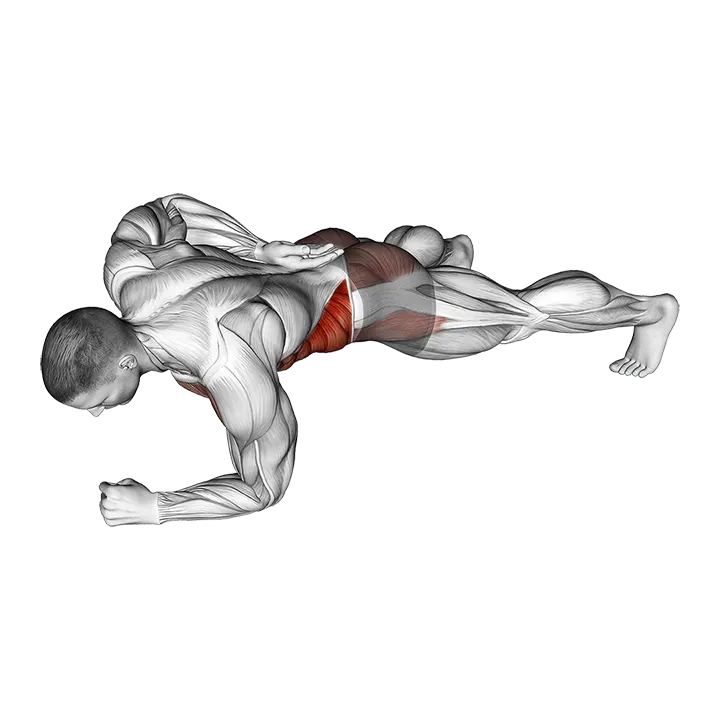
One Arm Front Plank
- Músculo objetivo
- Obliques, Rectus Abdominis
- Músculos sinergistas
- Deltoid Anterior, Pectoralis Major Clavicular Head, Pectoralis Major Sternal Head, Tensor Fasciae Latae
- Equipamiento
- Body weight
- Parte del cuerpo
- Waist
- Tipo
- Strength




The one arm front plank is a challenging bodyweight core exercise that primarily targets the obliques and rectus abdominis while demanding significant stability from the anterior deltoid, pectoralis major, and tensor fasciae latae. By removing one arm from the base of support, it forces the entire core to resist rotation and lateral collapse. It is well suited for intermediate and advanced trainees looking to build anti-rotation strength and unilateral shoulder stability.
Cómo hacer el One Arm Front Plank
- 1Set up in a standard forearm plank position with both forearms on the floor, elbows directly under your shoulders, and your body forming a straight line from head to heels.
- 2Brace your core hard — draw your navel gently in, squeeze your glutes, and press your forearm into the floor to create full-body tension before you lift anything.
- 3Shift your weight slightly onto one forearm, distributing it evenly across that arm to keep your shoulder stable.
- 4Slowly lift the opposite arm off the floor and extend it straight in front of you, keeping it in line with your body rather than reaching wide.
- 5Hold your hips level — your pelvis should not rotate, hike, or sag as the arm comes up.
- 6Keep your gaze down and slightly forward to maintain a neutral neck, and breathe steadily throughout the hold.
- 7Hold the position for the prescribed duration, then lower the raised arm back to the floor with control.
- 8Rest briefly, then repeat on the other side.
Consejos de técnica
- Think of your body as a rigid plank — any rotation at the hips means your core is not bracing hard enough; tighten it more before each rep.
- Press your supporting forearm firmly into the floor to engage the anterior deltoid and pectoralis major and keep the shoulder from shrugging up toward your ear.
- Widen your feet slightly beyond hip-width to increase your base of support, which makes it easier to resist rotation while you build the movement.
- Keep the raised arm parallel to the floor rather than letting it drift up or down, which helps your obliques maintain even tension across both sides.
- Exhale steadily during the hold instead of holding your breath — controlled breathing maintains intra-abdominal pressure without spiking blood pressure.
Errores comunes
- Allowing the hips to rotate toward the supporting arm, which offloads the obliques and turns the exercise into a side lean rather than an anti-rotation hold.
- Letting the hips sag toward the floor, which compresses the lower back and removes tension from the rectus abdominis.
- Hiking the hip on the unsupported side upward to compensate for weak lateral stability, creating an uneven load on the spine.
- Planting the raised arm out to the side rather than straight ahead, which reduces the rotational demand and shortens the lever arm on the core.
- Rushing into the arm lift before the core is fully braced, causing a brief collapse of tension that puts sudden stress on the supporting shoulder.
Preguntas frecuentes
What muscles does the one arm front plank work?
It primarily targets the obliques and rectus abdominis. The anterior deltoid, clavicular and sternal heads of the pectoralis major, and tensor fasciae latae assist by stabilizing the supporting arm and keeping the hips level.
How long should I hold the one arm front plank?
Start with 10–20 second holds per side and build up to 30–45 seconds as your core stability improves. Quality of position matters more than duration — reduce the hold time before you let form break down.
Is the one arm front plank suitable for beginners?
It is better suited to trainees who can already hold a solid two-arm forearm plank for at least 45–60 seconds, since it requires a substantially higher level of anti-rotation strength and shoulder stability.
How does the one arm front plank differ from a standard plank?
Removing one arm narrows the base of support and creates a rotational force that the obliques must actively resist. This makes the anti-rotation demand far greater than in a standard two-arm plank.
Can I do this exercise on my hand instead of my forearm?
Yes — performing it from a straight-arm plank position on one hand increases the lever arm and the demand on the anterior deltoid and pectoralis major, making it harder still. Master the forearm version first.