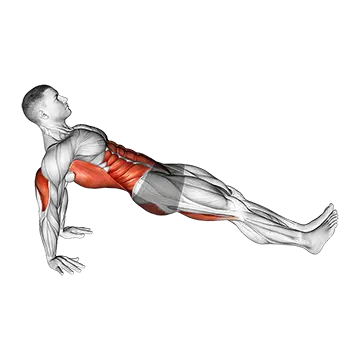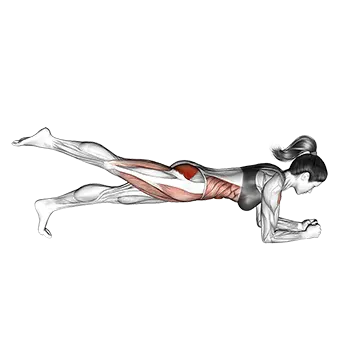
Pelvic Tilt
- Músculo objetivo
- Gluteus Maximus, Rectus Abdominis
- Músculos sinergistas
- Hamstrings, Iliopsoas
- Equipamiento
- Body weight
- Parte del cuerpo
- Waist
- Tipo
- Strength
The pelvic tilt is a foundational core and glute exercise that primarily targets the gluteus maximus and rectus abdominis, with assistance from the hamstrings and iliopsoas. Performed lying on your back, it teaches proper lumbar control and is widely used for core activation, lower-back relief, and as a warm-up or rehabilitation drill.
Cómo hacer el Pelvic Tilt
- 1Lie on your back on a flat surface with your knees bent and feet flat on the floor, hip-width apart.
- 2Place your arms at your sides with your palms facing down for support.
- 3Take a breath in to prepare, then exhale and gently draw your lower abs inward.
- 4Press your lower back into the floor by rotating your pelvis upward — imagine flattening the gap between your spine and the surface beneath you.
- 5Squeeze your glutes and brace your core at the top of the movement, holding for 2–3 seconds.
- 6Slowly release the contraction, allowing your lower back to return to its natural neutral position.
- 7Repeat for the desired number of reps, maintaining smooth, controlled breathing throughout.
Consejos de técnica
- Focus on using your abs and glutes to drive the movement rather than pushing through your feet — the legs should remain relatively passive.
- Keep the movement small and deliberate; this is not a bridge — your hips should stay on the floor throughout.
- Breathe out as you tilt and in as you release to reinforce proper intra-abdominal pressure.
- Move through a comfortable range of motion and avoid forcing your back flat if it causes discomfort.
Errores comunes
- Driving through the heels and lifting the hips off the floor, which turns the exercise into a glute bridge and removes the focus from spinal control.
- Holding your breath during the tilt, which increases tension and prevents proper core engagement.
- Using too large a range of motion and hyperextending or over-flattening the spine, which can aggravate rather than relieve lower-back discomfort.
- Rushing through reps without a pause at the top, which reduces time under tension and limits the neuromuscular benefit of the exercise.
Preguntas frecuentes
What muscles does the pelvic tilt work?
The pelvic tilt primarily works the gluteus maximus and rectus abdominis. The hamstrings and iliopsoas assist in stabilizing and controlling the movement.
Is the pelvic tilt good for lower back pain?
Yes — the pelvic tilt is commonly recommended as a gentle exercise to reduce lower-back discomfort by improving lumbar mobility and strengthening the surrounding core muscles. Always consult a healthcare professional if you have an existing back condition.
How many reps should I do for the pelvic tilt?
For general core activation or warm-up purposes, 2–3 sets of 10–15 slow, controlled reps works well. Hold each tilt for 2–3 seconds to maximize muscle engagement.
What is the difference between a pelvic tilt and a glute bridge?
A pelvic tilt keeps your hips on the floor and focuses on rotating the pelvis to activate the core and glutes in a small range of motion. A glute bridge drives the hips upward off the floor, loading the glutes and hamstrings through a much larger range.