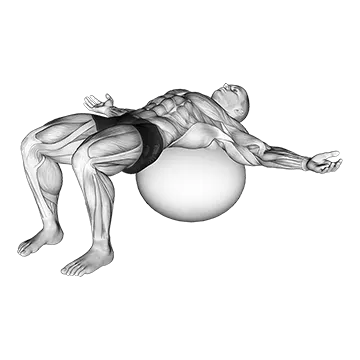
Plate Hyperextension
- Músculo objetivo
- Erector Spinae
- Músculos sinergistas
- Gluteus Maximus, Hamstrings
- Equipamiento
- Weighted
- Parte del cuerpo
- Hips
- Tipo
- Strength



The plate hyperextension is a weighted back-extension exercise performed on a Roman chair that primarily targets the erector spinae, with the gluteus maximus and hamstrings acting as key synergists. By holding a weight plate at your chest, you add progressive resistance to the standard bodyweight hyperextension, making it an effective strength exercise for building lower-back resilience and posterior-chain power.
Cómo hacer el Plate Hyperextension
- 1Set up the Roman chair so the pad sits just below your hip bones, leaving your upper body free to hinge forward without restriction.
- 2Hook your ankles under the foot pads and stand upright, spine neutral, core braced, and gaze directed slightly forward.
- 3Hold a weight plate against your chest with both hands, pressing it close to your sternum and keeping it there throughout the movement.
- 4Hinge at the hips and lower your torso slowly toward the floor until your body is roughly perpendicular to the ground.
- 5Pause briefly at the bottom without rounding your lower back, keeping tension in the posterior chain.
- 6Squeeze your glutes and drive your hips into the pad as you raise your torso back to the starting position.
- 7Stop when your body forms a straight line from head to heels — do not hyperextend past neutral at the top.
- 8Complete your reps under control, resetting your brace between reps if needed.
Consejos de técnica
- Keep your chin tucked and your gaze toward the floor at the bottom of each rep to maintain a neutral cervical spine and avoid straining your neck.
- Lead the upward movement with your glutes rather than snapping through your lower back — think of squeezing your glutes first, then letting the spine follow.
- Start with a lighter plate and master the full range of motion before adding load; the lower back fatigues quickly under resistance and form breaks down fast.
- Breathe in as you lower your torso and exhale as you drive back up, using the breath to reinforce core stability throughout each rep.
Errores comunes
- Hyperextending the lumbar spine past neutral at the top of the rep, which compresses the vertebrae and raises the risk of disc injury.
- Swinging the torso upward with momentum rather than lifting with the posterior chain, which reduces muscle activation and can strain the lower back.
- Holding the plate away from the chest or extended overhead, which shifts the load unfavorably, increases the moment arm on the spine, and amplifies spinal stress.
- Positioning the pad too high on the hips so it blocks full hip flexion, cutting the range of motion short and reducing erector spinae activation.
- Rounding the upper back at the bottom of the movement instead of maintaining a flat spine, which transfers shear force directly onto the lumbar vertebrae.
Preguntas frecuentes
What muscles does the plate hyperextension work?
The plate hyperextension primarily targets the erector spinae — the muscles running along both sides of the spine. The gluteus maximus and hamstrings act as synergists, driving hip extension as you return to the upright position.
How heavy a plate should I use for plate hyperextensions?
Start with a 5–10 kg (10–25 lb) plate until you can complete 3 sets of 12–15 reps with full control and no lower-back rounding. Increase the plate weight only once your form is solid through the entire range of motion.
How is the plate hyperextension different from the bodyweight hyperextension?
The movement pattern is identical — you hinge at the hips on a Roman chair — but holding a plate at your chest adds external resistance. This turns the exercise from a muscular-endurance drill into a genuine strength stimulus for the erector spinae and posterior chain.
How many sets and reps should I do?
For lower-back strength and hypertrophy, 3–4 sets of 8–12 reps with a challenging plate works well. For endurance or as an accessory warm-up, 2–3 sets of 15–20 reps with a lighter plate is effective.
Is the plate hyperextension safe for people with lower-back problems?
It depends on the nature of the issue. The exercise can strengthen the lower back when performed with proper form and conservative loads, but anyone with a herniated disc, acute lower-back pain, or a diagnosed spinal condition should consult a clinician before attempting it.