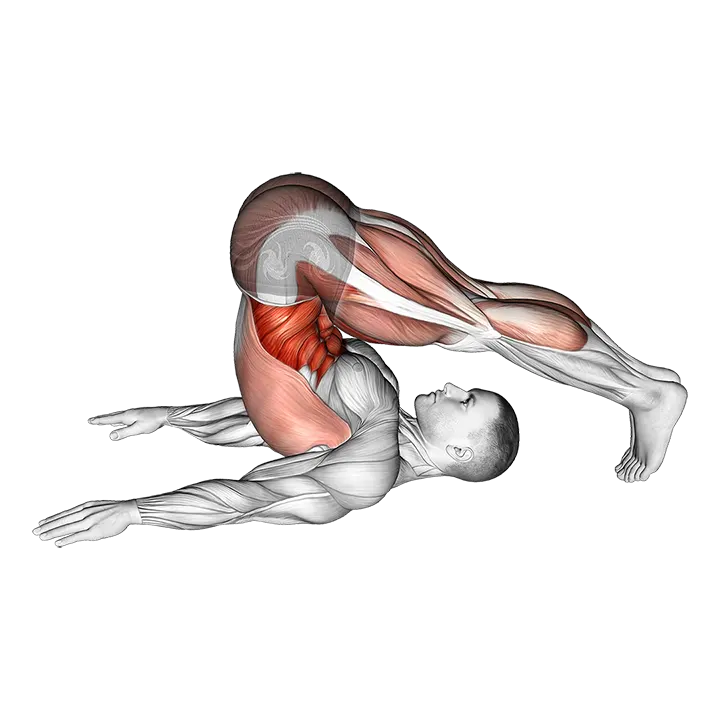
Plow Yoga Pose
- Músculo objetivo
- Obliques, Rectus Abdominis
- Músculos sinergistas
- Adductor Magnus, Gastrocnemius, Gluteus Maximus, Gluteus Medius, Hamstrings, Latissimus Dorsi, Quadriceps, Tensor Fasciae Latae
- Equipamiento
- Body weight
- Parte del cuerpo
- Waist
- Tipo
- Stretching
Plow Yoga Pose is a supine inversion that works the obliques and rectus abdominis to control the fold, with the latissimus dorsi, gluteus maximus, and quadriceps assisting while the hamstrings and gastrocnemius lengthen. Performed using only body weight, it takes the spine into deep flexion and stretches the posterior chain from the calves to the upper back. This pose is ideal for improving spinal flexibility and winding down after intense training.
Cómo hacer el Plow Yoga Pose
- 1Lie flat on your back on a mat with your arms alongside your torso, palms pressing down into the floor.
- 2Engage your core and exhale as you lift both legs off the floor, bringing them to a 90-degree angle above your hips.
- 3Continue to press your palms into the floor and slowly lower your legs over your head, reaching your feet toward the floor behind your head.
- 4Keep your legs as straight as possible, using your quadriceps to hold the knees extended while the hamstrings lengthen.
- 5Once your toes touch or approach the floor, interlace your fingers behind your back and press your arms into the mat to create stability.
- 6Keep your neck long and your gaze toward your chest, and hold the pose, breathing steadily for 5–10 slow breaths.
- 7To exit, unclasp your hands, place your palms back on the mat, and slowly roll your spine back down to the floor one vertebra at a time.
- 8Lower your legs with control back to the starting position and rest briefly in a neutral supine position.
Consejos de técnica
- Keep your neck relaxed and do not turn your head while in the pose — cervical compression is a real risk.
- Support your lower back with your hands if your feet do not reach the floor, rather than forcing the stretch.
- Press your upper arms firmly into the mat to stabilize the shoulder girdle and protect your neck.
- Tuck your shoulders under and draw your shoulder blades together so the upper back, not the neck, carries the load.
- Breathe slowly and consistently throughout; holding your breath increases internal pressure and reduces the stretch benefit.
Errores comunes
- Throwing the legs overhead quickly — momentum strains the cervical spine and lower back; move slowly and under control.
- Letting the knees bend excessively — this shortens the hamstring and calf stretch and lets the legs rest on the neck instead of stacking over the hips.
- Turning or rolling the head to the side — this puts dangerous asymmetrical load on the neck; keep the head still and centered.
- Collapsing the shoulders inward — failing to press the arms into the mat removes support from the upper back and increases neck compression.
- Forcing the feet to the floor when flexibility is insufficient — this rounds the upper back excessively and compresses the cervical vertebrae; use a prop or reduce depth instead.
Preguntas frecuentes
What muscles does Plow Yoga Pose work?
Plow Yoga Pose targets the obliques and rectus abdominis, which control the fold, while the latissimus dorsi, gluteus maximus, gluteus medius, and quadriceps assist. The stretch itself is felt down the posterior chain, mainly in the hamstrings and gastrocnemius.
Is Plow Yoga Pose safe for beginners?
It can be done by beginners with caution — avoid forcing the feet to the floor, and support the lower back with your hands if needed. Anyone with neck, shoulder, or spinal issues should consult a professional before attempting this pose.
How long should I hold Plow Yoga Pose?
Aim for 5–10 slow breaths, roughly 30–60 seconds, once your flexibility allows a comfortable hold. Beginners can start with shorter holds and increase duration gradually as the hamstrings and lower back open up.
Where should I feel Plow Yoga Pose?
You should feel a long stretch through the hamstrings, calves, and along the spine and upper back. You should not feel sharp pressure or pinching in the neck — if you do, come out of the pose and reduce the depth.
What equipment do I need for Plow Yoga Pose?
No equipment is required — Plow Yoga Pose is a body-weight exercise. A yoga mat or padded surface is recommended to protect the cervical spine and upper back during the inversion.