
Resistance Band Lying Leg Raise
- Músculo objetivo
- Gluteus Medius
- Músculos sinergistas
- Tensor Fasciae Latae
- Equipamiento
- Resistance Band
- Parte del cuerpo
- Hips
- Tipo
- Strength
The resistance band lying leg raise is a hip-focused strength exercise that targets the gluteus medius, with the tensor fasciae latae contributing as a synergist. Performed on your side with a band looped around your legs, it isolates the outer hip muscles through a controlled range of motion. It is well suited for building hip stability, correcting lateral hip weakness, and reinforcing glute activation patterns.
Cómo hacer el Resistance Band Lying Leg Raise
- 1Loop a resistance band just above your knees or around your ankles, depending on the resistance level you want.
- 2Lie on your side on a mat with your body in a straight line, hips stacked directly on top of each other, and your bottom arm extended beneath your head for support.
- 3Bend your bottom knee slightly for balance if needed, keeping your top leg straight and in line with your torso.
- 4Engage your core and press your hips forward slightly to prevent your top hip from rolling back during the movement.
- 5Slowly raise your top leg toward the ceiling, leading with your heel, until it reaches roughly 45 degrees above the floor or until your hips begin to rotate.
- 6Pause briefly at the top, actively squeezing the outer hip muscles against the band's resistance.
- 7Lower your top leg back down in a controlled manner until it is just above the bottom leg, maintaining constant tension in the band.
- 8Complete all reps on one side, then switch to the other side and repeat.
Consejos de técnica
- Keep your top hip stacked directly over your bottom hip throughout the movement — letting it drift backward shifts the work away from the gluteus medius.
- Move at a slow, deliberate tempo (2 seconds up, 2 seconds down) so the band provides meaningful resistance across the full range rather than just at the top.
- Lead the raise with your heel, not your toes, to keep the target muscles engaged rather than relying on hip flexor momentum.
- Brace your core before each rep to stabilize your pelvis and prevent your lower back from compensating for weak hip abductors.
Errores comunes
- Rolling the top hip backward during the raise, which recruits the hip flexors instead of the gluteus medius and reduces the effectiveness of the exercise.
- Using momentum to swing the leg up rather than lifting with control, which shortens the time under tension and limits muscle development.
- Letting the band go slack at the bottom of the rep, removing constant tension and allowing the muscles to rest mid-set.
- Raising the leg too high beyond the point where the hip starts to rotate, which transfers stress to the lower back instead of the target muscles.
- Allowing the hips to sink toward the floor rather than staying neutral, which compresses the shoulder and spine and creates poor alignment.
Preguntas frecuentes
What muscles does the resistance band lying leg raise work?
The primary muscle is the gluteus medius, located on the outer hip. The tensor fasciae latae acts as a synergist, assisting with hip abduction throughout the movement.
Where should I place the resistance band?
Placing the band just above the knees creates moderate resistance with a longer lever arm. Moving it to the ankles increases the difficulty. Start above the knees if you are new to the exercise and progress to the ankles as you get stronger.
How many reps should I do?
For muscle activation and endurance, 12–20 reps per side work well. If you are focusing on strength, use a heavier band and aim for 8–12 controlled reps where the last few feel genuinely challenging.
Can I do this exercise if I have hip pain?
Resistance band lying leg raises are often used in rehabilitation for hip and knee issues, but you should consult a physical therapist or physician before starting if you have existing hip pain to ensure the movement pattern is appropriate for your condition.
How do I make this exercise harder over time?
Progress by moving the band from above the knees to the ankles, switching to a band with greater resistance, slowing your tempo, or adding a pause at the top of each rep.
Ejercicios relacionados
 Resistance Band Bent Leg Side Kick (kneeling)Hips
 Resistance Band ClamHips
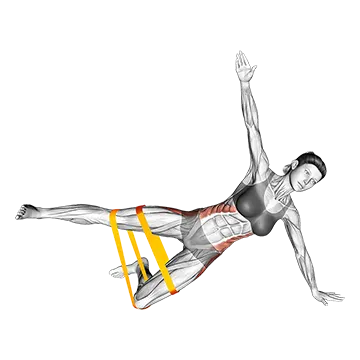 Resistance Band Kneeling Side PlankHips
 Resistance Band Lying AbductionHips
 Resistance Band Seated Hip AbductionHips
 Band Cross AbductionHips
 Band Hip AbductionHips
 Band horizontal Pallof Press with Resistance Band SquatHips, Thighs, Waist