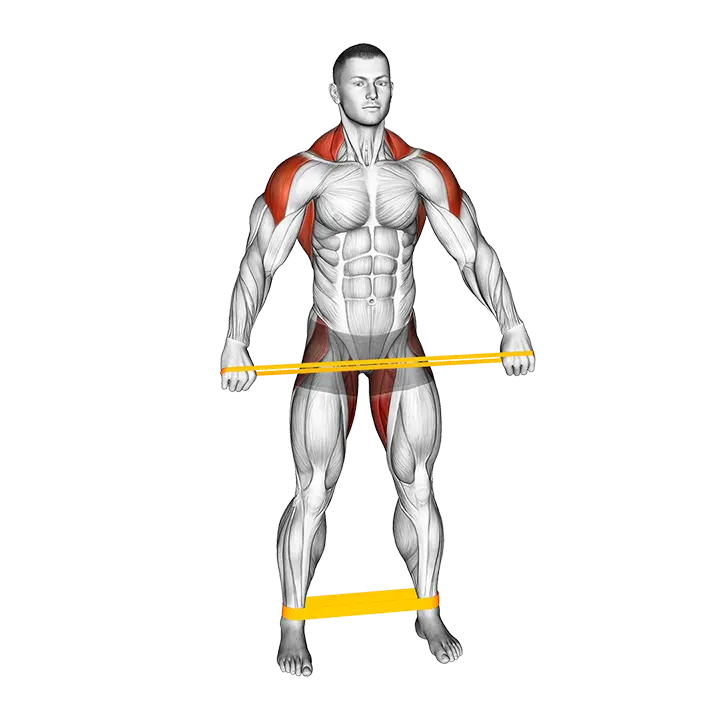
Resistance Band Standing Down Warming-up
- Músculo objetivo
- —
- Equipamiento
- Resistance Band
- Parte del cuerpo
- Back, Hips
- Tipo
- Stretching
The resistance band standing down warming-up is a pre-workout stretching drill that uses a resistance band to mobilize the back and hips through a controlled downward reach. By hinging and reaching downward against the band's gentle tension, you lengthen the muscles along the posterior chain, including the lower and mid-back and the hip region. It is well-suited as a warm-up before sessions that involve hinging, squatting, or any movement that demands lower-body and back range of motion.
Cómo hacer el Resistance Band Standing Down Warming-up
- 1Stand with feet hip-width apart and hold the resistance band in both hands with arms extended in front of you at roughly waist height.
- 2Engage your core lightly and stand tall with a neutral spine, soft knees, and your weight evenly distributed through both feet.
- 3Begin to hinge at the hips, sending them back as you slowly lower your torso and reach the band downward toward the floor, keeping your back flat rather than rounded.
- 4Continue lowering until you feel a stretch along your back and into your hips — stop before your lower back rounds under load.
- 5Hold the bottom position for 2–3 seconds, breathing out fully and allowing the back and hip muscles to relax into the stretch.
- 6Slowly reverse the movement by driving your hips forward and returning your torso to an upright position at the same controlled tempo.
- 7Repeat for the prescribed number of repetitions, moving smoothly through each rep and maintaining consistent band tension throughout the descent and return.
Consejos de técnica
- Keep your back flat during the downward reach — the stretch comes from the hip hinge, not from rounding through the lumbar spine.
- Bend your knees slightly if you feel tightness in the hamstrings that prevents you from hinging without rounding; a small knee bend allows the hips to move freely.
- Move slowly in both directions — a 2–3 second descent and a 2–3 second return gives the back and hip muscles time to warm up and respond to the stretch.
- Keep your grip relaxed and your shoulders away from your ears; tension in the upper traps limits how well the upper back can open during the movement.
- Choose a light band that provides just enough tension to make the movement deliberate — this is a warm-up drill, not a strength exercise.
Errores comunes
- Rounding the lower back at the bottom of the reach, which shifts load onto the lumbar spine rather than distributing the stretch across the back and hips where it belongs.
- Dropping down too quickly with momentum instead of a controlled descent, which reduces time under stretch and turns the drill into a swing rather than a mobility exercise.
- Locking the knees completely, which limits hip hinge depth and forces the lower back to compensate by flexing excessively.
- Holding the breath throughout the movement, which increases spinal tension and prevents the target muscles from relaxing — exhale on the way down to deepen the stretch.
- Using a band with too much resistance, which makes the movement feel like a strength exercise and shortens the range of motion by fighting the pull.
Preguntas frecuentes
What does the resistance band standing down warming-up stretch?
The exercise primarily targets the back and hips through a controlled downward hinging motion. The stretch is felt along the lower and mid-back and into the hip region, making it useful before any session involving bending, hinging, or squatting movements.
How many reps should I do as a warm-up?
8–12 slow, controlled repetitions are generally sufficient to warm up the back and hips before a workout. Focus on full range of motion and steady breathing rather than accumulating a high rep count.
Can I do this exercise if I have tight hamstrings?
Yes — bend your knees slightly to reduce hamstring pull and allow the hip hinge to move freely. As your hamstring flexibility improves over time, you can gradually straighten the legs.
What resistance level band should I use?
Choose a light band. The goal is gentle tension that keeps the movement deliberate without restricting range of motion. If the band is pulling you off balance or shortening your reach, switch to a lighter option.
When in my workout should I do this exercise?
Perform it at the start of your session as part of a dynamic warm-up, before lower-body or back-focused lifts such as deadlifts, squats, or rows. One to two sets is sufficient preparation.
Ejercicios relacionados
 Band horizontal Pallof Press with Resistance Band SquatHips, Thighs, Waist
 Landmine Resistance Band One Arm Shoulder PressShoulders
 Resistance Band 45 Degree Hip Extension Glute FocusedHips
 Resistance Band 45 degrees HyperextensionHips
 Resistance Band Adduction Split SquatThighs
 Resistance Band Air BikeWaist
 Resistance Band Air Bike (VERSION 2)Waist
 Resistance Band Alternating Split Stance Pallof PressWaist