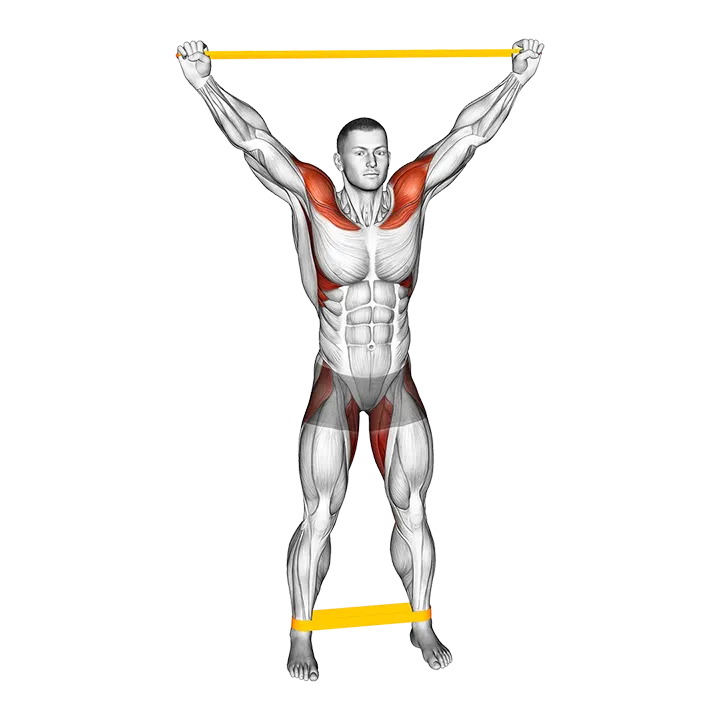
Resistance Band Standing Overhead Warming-up
- Músculo objetivo
- —
- Equipamiento
- Resistance Band
- Parte del cuerpo
- Hips, Shoulders
- Tipo
- Stretching
The Resistance Band Standing Overhead Warming-up is a dynamic mobility exercise that opens the hips and shoulders while priming overhead range of motion before training. Using a resistance band to guide movement, it gently increases blood flow and tissue extensibility across both areas, making it ideal as a pre-workout warm-up for overhead pressing, squatting, or any session demanding full-body mobility.
Cómo hacer el Resistance Band Standing Overhead Warming-up
- 1Stand tall with your feet hip-width apart and step or hold one end of the resistance band underfoot, or anchor it at a low point behind you, creating light tension.
- 2Grasp the band with both hands at roughly shoulder width, arms hanging in front of your thighs with palms facing inward.
- 3Brace your core lightly, set your hips square, and soften your knees slightly so you are in a neutral, athletic stance.
- 4Begin the movement by raising both arms forward and overhead in a smooth arc, keeping a small amount of tension in the band throughout.
- 5At the top, allow your arms to reach fully overhead — biceps close to your ears — while simultaneously pressing your hips gently forward to open the hip flexors.
- 6Pause for one to two seconds at the top position, feeling a mild stretch across your shoulders and the front of your hips.
- 7Slowly lower your arms back along the same arc to the starting position, maintaining control of the band so it does not snap loose.
- 8Reset your stance and posture, then repeat for the desired number of repetitions.
Consejos de técnica
- Use a light band — this is a warm-up, so the goal is guided mobility, not resistance; enough tension to feel the band but never enough to limit overhead reach.
- Exhale as you raise the band overhead and inhale as you return to the start; controlled breathing helps relax the shoulder and hip tissues.
- Move slowly and rhythmically rather than swinging; a two-count up and two-count down tempo keeps you in the mobilizing range and out of momentum.
- Keep your ribs down and avoid arching your lower back as the arms reach overhead — let the hips and shoulders open without compensating through the spine.
Errores comunes
- Using a band with too much resistance, which restricts full overhead reach and defeats the purpose of the warm-up by building tension instead of releasing it.
- Arching the lower back aggressively to force the arms overhead, which shifts stress onto the lumbar spine instead of mobilizing the shoulders.
- Shrugging the shoulders up toward the ears during the lift, which creates neck tension and prevents true shoulder mobility from being developed.
- Rushing through reps without pausing at the top, which eliminates the brief stretch needed to signal the tissues to relax and lengthen.
- Letting the hips drift backward or the knees lock out stiffly, which reduces the hip-flexor opening component of the movement.
Preguntas frecuentes
What does the Resistance Band Standing Overhead Warming-up target?
It targets mobility and tissue preparation in the hips and shoulders. The overhead reach mobilizes the shoulder joints and surrounding musculature, while the simultaneous hip extension position gently stretches the front of the hips, making it a full-chain warm-up movement.
When should I do this exercise in my workout?
Perform it at the start of your session as part of a dynamic warm-up, before any overhead pressing, squatting, or Olympic lifting work. Two to three sets of 8–12 slow, controlled reps is typically enough to prime both areas.
How many reps and sets should I do?
For warm-up purposes, 2–3 sets of 8–12 reps at a slow, controlled tempo is sufficient. The focus should be on quality of movement and achieving full range of motion on each rep rather than accumulating volume.
What resistance band strength should I use?
Choose the lightest band that still provides noticeable guidance — typically an extra-light or light band. The band should create just enough feedback to feel the path of the movement without pulling your arms down or preventing you from reaching fully overhead.
Who should include this exercise in their routine?
Anyone who performs overhead movements — such as shoulder pressing, pull-ups, snatches, or wall balls — will benefit from it. It is also useful for people who sit for long periods and carry tightness through the hip flexors and thoracic spine, as it addresses both areas in a single standing movement.
Ejercicios relacionados
 Band horizontal Pallof Press with Resistance Band SquatHips, Thighs, Waist
 Landmine Resistance Band One Arm Shoulder PressShoulders
 Resistance Band 45 Degree Hip Extension Glute FocusedHips
 Resistance Band 45 degrees HyperextensionHips
 Resistance Band Adduction Split SquatThighs
 Resistance Band Air BikeWaist
 Resistance Band Air Bike (VERSION 2)Waist
 Resistance Band Alternating Split Stance Pallof PressWaist