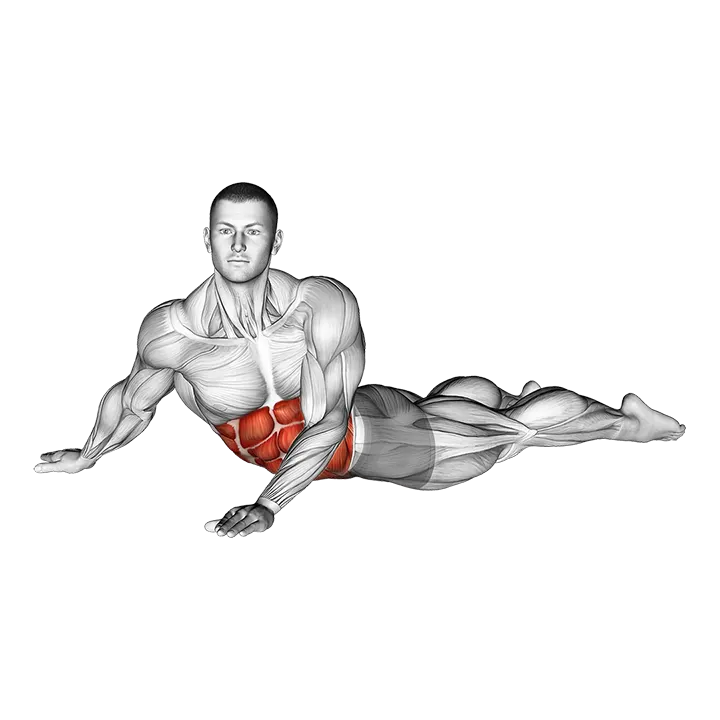
Rotating Stomach Stretch
- Músculo objetivo
- Obliques, Rectus Abdominis
- Equipamiento
- Body weight
- Parte del cuerpo
- Waist
- Tipo
- Stretching




The Rotating Stomach Stretch is a prone spinal extension and rotation stretch that targets the obliques and rectus abdominis. Starting from a cobra-style press-up, you gently rotate your torso to each side to lengthen the abdominal wall and improve spinal mobility. It works well as a cool-down or flexibility drill after core-intensive training.
Cómo hacer el Rotating Stomach Stretch
- 1Lie face down on a mat with your legs extended and your hands placed flat beside your shoulders, fingers pointing forward.
- 2Press through your hands to lift your chest and torso off the mat, straightening your arms as far as your flexibility comfortably allows while keeping your hips in contact with the floor — this is your starting position.
- 3Take a slow breath in to lengthen and decompress your spine.
- 4Exhale and gently rotate your torso to the right, looking over your right shoulder until you feel a stretch along the left side of your abdomen and obliques.
- 5Hold the rotated position for 20–30 seconds, breathing steadily without forcing the range.
- 6Return your gaze forward and bring your torso back to center with control.
- 7Rotate to the left, looking over your left shoulder, and hold for the same duration.
- 8Lower yourself back to the mat and repeat for the desired number of sets.
Consejos de técnica
- Keep your hips pressed into the mat throughout — lifting them reduces the stretch on the abdominal wall and shifts stress onto the lower back.
- Let the rotation originate from your mid-back (thoracic spine) rather than simply turning your head; this ensures the obliques are actually being lengthened.
- Move into each rotation slowly and steadily — passive breathing helps the abdominal muscles release further over the hold.
- If you feel sharp or pinching pain in your lower back at the top of the press-up, reduce the height by resting on your forearms (sphinx position) instead of fully extended arms.
Errores comunes
- Hyperextending the lower back by pressing too high too fast, which compresses the lumbar spine and can cause pain — extend only as far as you can without discomfort.
- Rotating at the neck rather than through the thoracic spine, which strains the cervical vertebrae and bypasses the target muscles entirely.
- Holding your breath during the hold, which keeps the core braced and limits how far the obliques can lengthen.
- Rushing through each rotation without pausing, so the muscle never fully releases and the stretch produces little flexibility benefit.
- Allowing the hips to lift off the mat during the rotation, which reduces abdominal tension and turns the movement into a side-bend rather than a true rotation stretch.
Preguntas frecuentes
What muscles does the Rotating Stomach Stretch target?
It primarily targets the obliques and rectus abdominis. The cobra press-up component lengthens the entire front abdominal wall, while the rotation emphasizes the obliques on the side opposite the direction you rotate.
Is the Rotating Stomach Stretch safe for people with lower back pain?
It depends on the cause. Lumbar extension can relieve some forms of lower-back tightness but may aggravate disc-related issues. Reduce the height of the press-up or switch to the forearm (sphinx) position if you feel discomfort, and consult a physiotherapist if pain persists.
How long should I hold each side of the Rotating Stomach Stretch?
Aim for 20–30 seconds per side. This is typically enough time for the targeted muscles to relax and begin to lengthen; holds shorter than 15 seconds tend to produce minimal flexibility gains.
When is the best time to do the Rotating Stomach Stretch?
It fits best as part of a post-workout cool-down after core or abdominal exercises, or in a standalone mobility session. Avoid it immediately before heavy lifting, as prolonged static stretching can temporarily reduce muscle activation.
What are good alternatives to the Rotating Stomach Stretch?
The standard cobra or sphinx stretch targets the rectus abdominis without the rotation, while the seated spinal twist works the obliques from an upright position. Both are useful substitutes if the prone position is uncomfortable.