
Seated Sky Look
- Equipamiento
- Body weight
- Parte del cuerpo
- Chest
- Tipo
- Strength
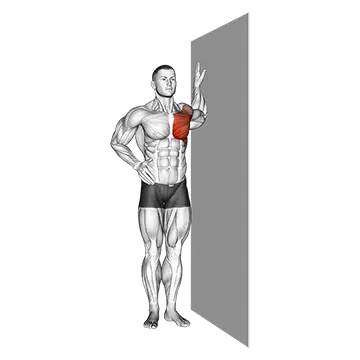


The Seated Sky Look is a bodyweight chest-opener that targets the anterior deltoid and both the clavicular and sternal heads of the pectoralis major through a seated thoracic rotation and upward gaze. It improves upper-body mobility, counters the effects of prolonged sitting, and reinforces anterior shoulder and chest activation without any equipment.
Cómo hacer el Seated Sky Look

- 1Sit upright on a chair or on the floor with your feet flat and your spine tall.
- 2Place both hands behind your head, fingers interlaced, elbows wide.
- 3Inhale to prepare, then rotate your torso to the right, leading with your right elbow.
- 4As you reach the end of your rotation, extend your thoracic spine and tilt your head back to look upward toward the ceiling.
- 5Hold the top position for one to two seconds, feeling the stretch across your chest and the front of your shoulder.
- 6Exhale as you return your torso to the starting position in a controlled manner.
- 7Repeat for the prescribed number of repetitions on the right side, then perform the same sequence rotating to the left.
Consejos de técnica
- Initiate the movement from your mid-back rather than your lower back to target the thoracic spine and engage the chest effectively.
- Keep your elbows pulled wide throughout the movement so the chest stays open and the anterior deltoid works through its full range.
- Avoid pulling on your neck with your hands — let your head follow the rotation passively.
- Breathe in before rotating and exhale on the return to maintain intra-abdominal stability.
- Sit on the front edge of your seat to prevent the chair back from restricting your rotation.
Errores comunes
- Rotating only at the lower back instead of the thoracic spine — this reduces chest and anterior deltoid engagement and can place undue stress on the lumbar vertebrae.
- Letting the elbows collapse forward during the rotation — this closes off the chest and defeats the purpose of the chest-opener movement.
- Pulling the neck into forced extension with the hands — this strains the cervical spine and shifts focus away from the target muscles.
- Rushing through the top position without pausing — cutting the hold short reduces time under tension and limits the stretch benefit to the pectoralis major.
- Allowing the hips to rotate along with the torso — the hips should remain square so the movement is isolated to the upper body.
Preguntas frecuentes
What muscles does the Seated Sky Look work?
The Seated Sky Look primarily targets the anterior deltoid and both heads of the pectoralis major — the clavicular head at the upper chest and the sternal head across the mid-chest. The thoracic rotators and postural stabilizers of the spine assist throughout the movement.
Can I do the Seated Sky Look if I have tight shoulders?
Yes. Because the movement is controlled and uses only body weight, it is well-suited for people with tight anterior shoulders. Start with a smaller range of rotation and extension, and gradually increase range as mobility improves over multiple sessions.
How many reps and sets should I do for the Seated Sky Look?
For mobility and activation purposes, two to three sets of eight to twelve repetitions per side is a common starting point. If using it as a warm-up, one to two sets of six to eight reps per side is sufficient to prepare the chest and shoulders.
Is the Seated Sky Look effective as a standalone chest exercise?
It is best used as a mobility primer, warm-up movement, or active recovery exercise rather than a primary strength builder. It activates the anterior deltoid and pectoralis major through a stretch-and-contract pattern but does not provide the progressive overload needed for significant hypertrophy on its own.
What is the difference between the Seated Sky Look and a seated thoracic rotation?
A standard seated thoracic rotation focuses on spinal mobility without the upward gaze. The Seated Sky Look adds cervical and thoracic extension at the top of the rotation, which increases the stretch on the chest and anterior shoulder and more directly engages the pectoralis major clavicular head.