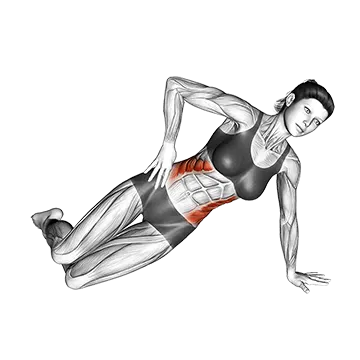
Side Bridge with Straight Legs
- Músculo objetivo
- Obliques
- Equipamiento
- Body weight
- Parte del cuerpo
- Waist
- Tipo
- Strength
The side bridge with straight legs is an isometric bodyweight exercise that targets the obliques for lateral core stability. You prop yourself on one forearm with your legs fully extended and feet stacked, then hold your hips elevated so your body forms a straight line from head to heels. It is an effective hold for building anti-lateral-flexion strength and waist stability.
Cómo hacer el Side Bridge with Straight Legs
- 1Lie on your side on the floor with your legs fully extended and feet stacked on top of each other.
- 2Place your bottom forearm flat on the floor, elbow directly beneath your shoulder, forearm pointing forward.
- 3Stack your top hand on your hip or extend your top arm toward the ceiling.
- 4Brace your core and squeeze your glutes, then press your forearm into the floor to lift your hips off the ground.
- 5Raise your hips until your body forms a straight diagonal line from your head through your shoulders, hips, and heels.
- 6Hold the position, keeping your neck neutral and your gaze forward — avoid letting your head drop or crane upward.
- 7Breathe steadily throughout the hold; do not hold your breath.
- 8Lower your hips back to the floor under control to end the set, then repeat on the opposite side.
Consejos de técnica
- Drive your bottom elbow firmly into the floor to create a stable base and prevent your shoulder from rounding upward.
- Keep your hips squared to the front — avoid rotating them toward the floor or ceiling as fatigue builds.
- Actively squeeze your obliques and glutes throughout the hold to maintain a rigid plank and protect your lower back.
- If your hips sag, terminate the set rather than compromising form — quality time under tension matters more than duration.
- Ensure your elbow is directly below your shoulder before lifting; a misaligned elbow increases shoulder strain.
Errores comunes
- Letting the hips sag toward the floor, which eliminates tension on the obliques and places stress on the lumbar spine.
- Piking the hips too high, which shifts the work away from the obliques and creates an unstable, ineffective position.
- Allowing the top shoulder to roll forward or backward, which reduces core engagement and strains the rotator cuff.
- Placing the elbow too far in front of or behind the shoulder, which destabilizes the supporting joint.
- Holding the breath, which spikes internal pressure and causes form to break down faster than it should.
Preguntas frecuentes
What muscles does the side bridge with straight legs work?
It primarily targets the obliques, which work isometrically to resist lateral flexion and keep your body in a straight line throughout the hold.
How long should I hold the side bridge?
Beginners can aim for 10–20 seconds per side and build up gradually. Intermediate trainees typically work toward 30–60 second holds, progressing duration before adding difficulty.
What is the difference between a side bridge and a side plank?
The terms are often used interchangeably. 'Side bridge with straight legs' specifically means both legs are fully extended and stacked — the most demanding standard variation — as opposed to a modified version with the knees bent.
Can I do this exercise every day?
Because it is an isometric hold with no eccentric loading, it recovers quickly. Many people include it daily as core maintenance work, but listen to your body and take rest if your shoulder or waist feels fatigued.