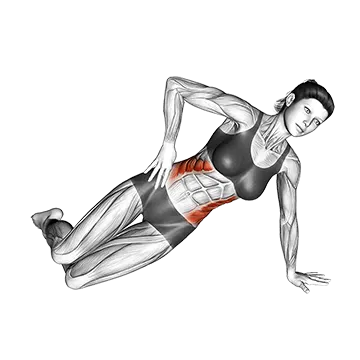
Side Crunch (version 2)
- Músculo objetivo
- Obliques
- Músculos sinergistas
- Rectus Abdominis
- Equipamiento
- Body weight
- Parte del cuerpo
- Waist
- Tipo
- Strength
The side crunch (version 2) is a bodyweight core exercise performed lying on your side that directly targets the obliques by curling your torso laterally, with the rectus abdominis acting as a synergist. This side-lying variation isolates each oblique independently, making it an effective accessory movement for building lateral core strength and waist definition.
Cómo hacer el Side Crunch (version 2)
- 1Lie on your side on a mat with your legs stacked on top of each other and your body in a straight line from head to toe.
- 2Bend your knees slightly to about 45° for stability, keeping your hips stacked directly on top of each other.
- 3Place your bottom arm extended along the floor in front of you for balance, and bring your top hand behind your head with your elbow pointing toward the ceiling.
- 4Engage your core and fix your gaze slightly upward to keep your neck in a neutral position.
- 5Exhale and crunch your torso upward and sideways, contracting the oblique on the top side to lift your shoulder off the mat.
- 6Hold the contracted position briefly at the top, feeling the squeeze in your oblique.
- 7Inhale and slowly lower your torso back to the starting position with control, avoiding letting your shoulder drop completely flat.
- 8Complete all reps on one side, then roll over and repeat on the opposite side.
Consejos de técnica
- Focus on contracting the oblique rather than pulling on your neck — your elbow should stay wide and your head should follow your torso, not lead it.
- Move slowly and deliberately on both the way up and down; momentum will rob the obliques of tension.
- Keep your hips stacked and prevent them from rolling backward or forward, which redirects the work away from the obliques.
- A short pause at the top of each rep intensifies the oblique contraction and ensures you are not relying on momentum.
Errores comunes
- Pulling on the neck with the hand behind the head, which strains the cervical spine and reduces oblique activation.
- Rolling the hips backward as you crunch up, turning the movement into a partial sit-up rather than a true lateral crunch.
- Using a large range of motion too quickly — speed reduces oblique tension and shifts the work to hip flexors.
- Forgetting to train both sides equally, which can reinforce or create muscular imbalances in the core.
- Holding your breath throughout the set; exhale on the crunch and inhale on the way down to maintain intra-abdominal control.
Preguntas frecuentes
What muscles does the side crunch (version 2) work?
It primarily targets the obliques — the muscles running diagonally along the sides of your waist — with the rectus abdominis (your six-pack muscles) assisting as a synergist.
What is the difference between side crunch version 1 and version 2?
Version 2 is performed lying fully on your side with legs stacked, isolating each oblique independently, whereas version 1 is typically done lying on your back with knees dropped to one side. The side-lying position in version 2 generally provides a more direct oblique contraction.
How many reps should I do for the side crunch?
Most people respond well to 2–4 sets of 12–20 reps per side. Because this is a bodyweight isolation movement, higher rep ranges with a focus on the mind-muscle connection are more effective than low-rep heavy loading.
Can the side crunch help reduce love handles?
The side crunch strengthens and develops the oblique muscles beneath the skin, but spot reduction of fat is not possible. Pairing this exercise with a calorie-controlled diet and full-body training will reduce overall body fat and reveal the oblique definition underneath.
Is it normal to feel the side crunch in my neck?
Neck discomfort usually means you are pulling your head with your hand rather than using your obliques to lift your torso. Keep your elbow wide, look slightly upward, and think of your hand as a gentle support rather than a lever.