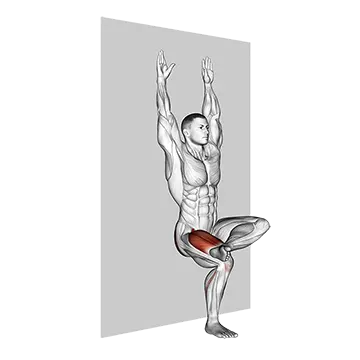
Sissy Squat
- Músculo objetivo
- Quadriceps
- Equipamiento
- Body weight
- Parte del cuerpo
- Thighs
- Tipo
- Strength
The sissy squat is a bodyweight knee-dominant isolation exercise that targets the quadriceps through an intense deep stretch. By leaning back on your toes while the knees travel far forward, it creates maximum quad tension without loading the hips — making it an effective finishing move for thigh development and quad hypertrophy.
Cómo hacer el Sissy Squat
- 1Stand with your feet hip-width apart near a wall, post, or rack you can lightly hold for balance.
- 2Rise onto the balls of your feet and keep your heels elevated throughout the movement.
- 3Begin the descent by simultaneously bending your knees forward and leaning your torso back, maintaining a straight line from your knees to your shoulders.
- 4Continue lowering until your thighs and torso approach parallel with the floor, or as deep as your flexibility and knee comfort allow.
- 5Hold the bottom position for a brief moment, feeling a deep stretch across the front of your thighs.
- 6Drive through the balls of your feet and contract your quadriceps to reverse the motion, pressing your hips forward as you rise.
- 7Return to the upright starting position with knees slightly soft — do not lock them out aggressively.
- 8Repeat for the desired number of reps, keeping each repetition slow and controlled.
Consejos de técnica
- Move slowly — a 3-second descent and 2-second ascent maximises time under tension on the quads and helps you stay in control as your knees travel forward.
- Keep your torso and thighs in one rigid line as you lean back; any break at the hips shifts tension away from the quads and unbalances the movement.
- Use a light grip on a support for balance only — do not pull yourself up with your arms, as this defeats the quad isolation.
- If you feel sharp pain in or around the knee joint, reduce your range of motion or stop and consult a professional; the sissy squat places significant stress on the knee and is not suitable for everyone.
- Build up depth gradually over multiple sessions rather than forcing full range on your first attempt.
Errores comunes
- Letting the heels drop to the floor, which removes the deep quad stretch and shifts the load away from the target muscle.
- Breaking at the hips and bending forward at the waist — this collapses the straight body line and reduces quad isolation while straining the lower back.
- Rushing through reps using momentum instead of muscular control, which decreases quad tension and increases injury risk at the knee.
- Gripping the support too tightly and pulling with the arms, turning a quad isolation exercise into an assisted whole-body movement.
- Attempting full range of motion too soon without adequate quad strength or knee preparation, placing excessive stress on the patellar tendon and knee joint.
Preguntas frecuentes
What muscles does the sissy squat work?
The sissy squat is an isolation exercise that targets the quadriceps almost exclusively. Because the hips remain extended and the torso leans back, the glutes and hamstrings play virtually no role, making it one of the purest quad exercises you can perform with bodyweight.
Are sissy squats bad for your knees?
Sissy squats place significant stress on the knee joint and patellar tendon because the knees travel well in front of the toes throughout the movement. They are not inherently dangerous for healthy knees when performed with proper technique and an appropriate range of motion, but anyone with existing knee issues should consult a medical professional before attempting them.
How do I make sissy squats harder without adding equipment?
Increase the difficulty by slowing the tempo (try a 4-second descent), pausing longer at the bottom, reducing support from the balance aid, or increasing your range of motion as your strength and flexibility improve.
How do sissy squats differ from regular squats?
In a regular squat the hips hinge back and the torso stays relatively upright, distributing load across the quads, glutes, and hamstrings. In a sissy squat the hips stay forward, the torso leans back, and the knees travel far forward — isolating the quadriceps and removing most of the contribution from the posterior chain.
Can beginners do sissy squats?
Sissy squats are generally better suited to intermediate or advanced trainees who have built a solid quad and knee strength base. Beginners should first develop their quads through exercises like bodyweight squats and lunges before progressing to the higher knee stress of the sissy squat.