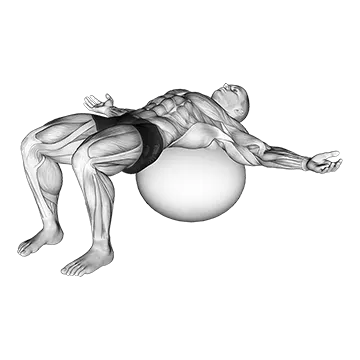
Stability Ball Reverse Hyperextension (off a bench)
- Músculo objetivo
- Erector Spinae, Gluteus Maximus
- Músculos sinergistas
- Hamstrings
- Equipamiento
- Stability ball
- Parte del cuerpo
- Hips
- Tipo
- Strength



The Stability Ball Reverse Hyperextension off a bench targets the erector spinae and gluteus maximus as primary muscles, with the hamstrings acting as synergists. By draping a stability ball over a flat bench and lifting the legs behind you, this exercise builds lower-back strength and glute development while the ball adds an element of balance challenge.
Cómo hacer el Stability Ball Reverse Hyperextension (off a bench)
- 1Place a flat bench in an open area and set a stability ball lengthwise on top of it.
- 2Lie face-down over the stability ball so your hips are centered on the ball and your torso rests on the bench; grip the sides or legs of the bench firmly for stability.
- 3Extend your legs straight back with your toes lightly touching the floor and your feet hip-width apart.
- 4Brace your core and squeeze your glutes, then exhale as you lift both legs upward until your body forms a straight line from shoulders to heels.
- 5Pause briefly at the top, focusing on contracting the erector spinae and gluteus maximus.
- 6Inhale and slowly lower your legs back toward the floor in a controlled manner, stopping just before your toes touch.
- 7Repeat for the desired number of repetitions without letting momentum drive the movement.
Consejos de técnica
- Move slowly throughout — a 2-second lift and 3-second lower maximizes time under tension and reduces injury risk.
- Keep your toes pointed and legs together if you want a greater glute squeeze, or feet hip-width apart for a more stable, beginner-friendly position.
- Breathe out on the way up and in on the way down to keep your core pressurized and your lower back protected.
- Press your hips firmly into the ball at the top of each rep rather than arching excessively through the lumbar spine.
- Ensure the bench is on a non-slip surface and grip it tightly — a stable upper body lets you focus all effort on the posterior chain.
Errores comunes
- Using momentum to swing the legs up: swinging reduces time under tension on the erector spinae and glutes, turning a strength exercise into a ballistic movement that raises injury risk.
- Hyperextending the lower back at the top: lifting the legs far past neutral compresses the lumbar vertebrae and shifts stress away from the target muscles onto the spine.
- Placing the ball too far forward or back: if the hips are not centered on the ball, the torso becomes unstable, forcing stabilizer muscles to compensate and reducing the training stimulus on the posterior chain.
- Holding the breath throughout the set: breath-holding spikes intra-abdominal pressure and can cause dizziness; exhale on the lift and inhale on the descent.
- Bending the knees during the lift: flexed knees shorten the lever arm and decrease the load on the glutes and hamstrings, diminishing the exercise's effectiveness.
Preguntas frecuentes
What muscles does the Stability Ball Reverse Hyperextension work?
The primary muscles are the erector spinae (muscles running along the spine) and the gluteus maximus. The hamstrings act as synergists, assisting with hip extension. The core and hip stabilizers are also engaged to keep your body controlled over the ball.
Is the Stability Ball Reverse Hyperextension good for beginners?
It can be suitable for beginners who have basic core stability, but the unstable surface of the ball adds a balance challenge. Beginners should start with a slow tempo, a light range of motion, and ensure the bench and ball are secure before adding reps or weight.
How many reps and sets should I do?
For strength and muscle development, aim for 3–4 sets of 10–15 reps with a controlled tempo. If building endurance or rehabilitating the lower back, higher rep ranges of 15–20 with a very light, deliberate movement are effective.
How does this compare to a regular hyperextension on a machine?
A machine hyperextension locks your hips in place and isolates the erector spinae more directly. The stability ball version adds a balance component that recruits more stabilizer muscles and slightly shifts emphasis to the glutes because the hips can move freely over the ball.
Is this exercise safe if I have lower-back pain?
Many people use reverse hyperextensions for lower-back rehabilitation because the movement decompresses the lumbar spine when done correctly. However, if you have an acute injury or herniated disc, consult a healthcare professional before attempting this exercise. Always avoid hyperextending past neutral and use a slow, controlled range of motion.