
Standing Ab Twist
- Músculo objetivo
- Obliques
- Músculos sinergistas
- Rectus Abdominis
- Equipamiento
- Body weight
- Parte del cuerpo
- Waist
- Tipo
- Strength


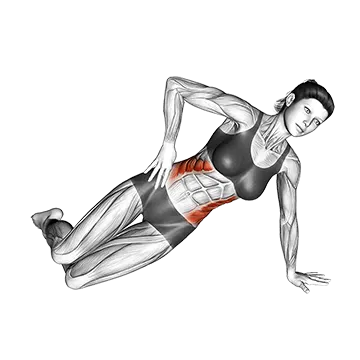

The Standing Ab Twist is a bodyweight core exercise that primarily targets the obliques, with assistance from the rectus abdominis. Performed upright, it trains rotational core strength and stability, making it a practical movement for athletes and anyone looking to build a stronger, more functional midsection.
Cómo hacer el Standing Ab Twist
- 1Stand with your feet shoulder-width apart, knees slightly bent, and your weight evenly distributed across both feet.
- 2Raise your arms out in front of you at chest height, either clasping your hands together or holding them parallel, keeping them straight throughout the movement.
- 3Brace your core and keep your hips square and facing forward — they should not rotate with your torso.
- 4Exhale and rotate your upper body to the right as far as your range of motion comfortably allows, leading with your shoulders.
- 5Pause briefly at the end of the rotation, feeling the contraction in your right oblique.
- 6Inhale and rotate back through center, then continue rotating to the left side with control.
- 7Pause at the left end range, feeling the contraction in your left oblique.
- 8Continue alternating sides in a smooth, controlled rhythm for the desired number of reps or time.
Consejos de técnica
- Keep your hips and lower body still throughout — the rotation should come entirely from your thoracic spine and obliques, not your hips.
- Move at a deliberate, controlled pace rather than swinging — speed reduces oblique engagement and increases injury risk.
- Keep your chest tall and avoid rounding your upper back, which limits your rotation range and shifts stress away from the target muscles.
- Exhale on each rotation to promote deeper core engagement and a stronger contraction.
Errores comunes
- Rotating the hips along with the torso, which reduces oblique isolation and turns the exercise into a whole-body swing.
- Using momentum to swing the arms side to side instead of contracting the core, which diminishes the training stimulus.
- Locking the knees straight, which creates tension in the lower back and limits thoracic rotation — keep a soft bend in the knees.
- Collapsing through the chest or rounding the shoulders, which compresses the spine and reduces the effective range of motion.
- Holding the breath throughout the set, which increases intra-abdominal pressure unnecessarily — breathe rhythmically with each rotation.
Preguntas frecuentes
What muscles does the Standing Ab Twist work?
The Standing Ab Twist primarily targets the obliques (both internal and external), which are the muscles responsible for rotating and side-bending the trunk. The rectus abdominis acts as a synergist, helping to stabilize the spine throughout the movement.
How is the Standing Ab Twist different from a Russian Twist?
Both exercises train rotational oblique strength, but they differ in position and demands. The Russian Twist is performed seated with the torso leaned back, adding a hip-flexor challenge. The Standing Ab Twist is done upright, which requires more total-body stability and is easier on the hip flexors, making it a good option for those with lower-back sensitivity.
Can the Standing Ab Twist help reduce belly fat or slim the waist?
The Standing Ab Twist strengthens and tones the obliques and core muscles, but spot reduction of fat in one area is not possible through exercise alone. A combination of consistent training, adequate protein, and a slight caloric deficit is what drives overall fat loss, and the twist contributes to a stronger, more defined midsection as body fat decreases.
How many reps and sets should I do?
For general core strength and endurance, 2–4 sets of 15–25 twists per side (or 30–50 total alternating reps) works well. You can also use time — 20–40 seconds per set. Keep rest periods short (30–60 seconds) if you want more of a conditioning effect.
Is the Standing Ab Twist safe for people with lower back pain?
For many people with mild lower-back discomfort, standing rotational exercises are more comfortable than floor or seated variants because there is less spinal flexion involved. However, if rotation itself aggravates your pain, stop and consult a healthcare professional. Always move within a pain-free range and avoid forcing the rotation.