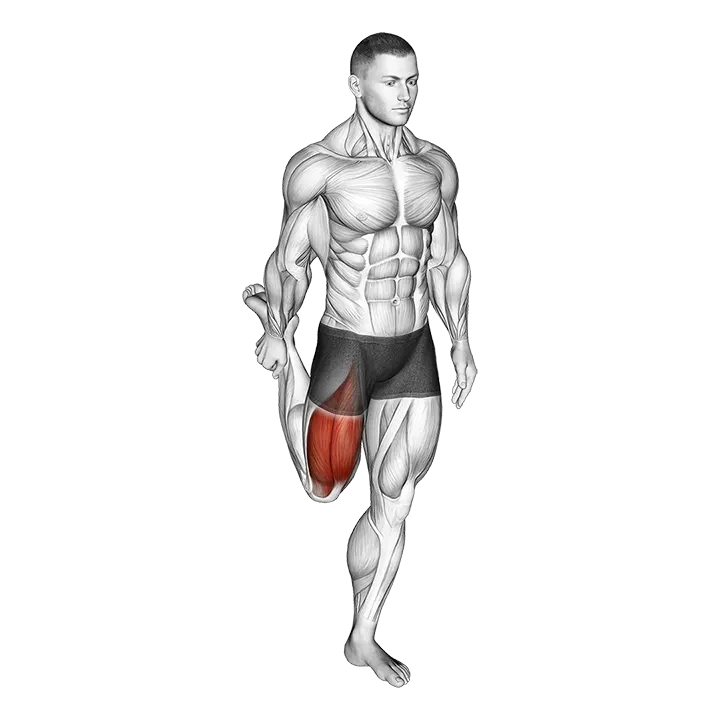
Standing Balance Quadriceps Stretch
- Músculo objetivo
- Quadriceps
- Equipamiento
- Body weight
- Parte del cuerpo
- Thighs
- Tipo
- Stretching

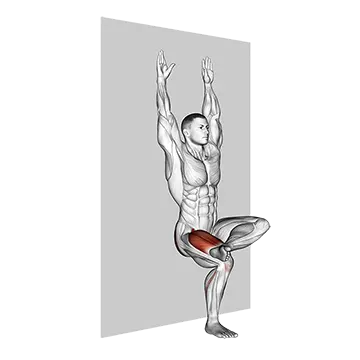
The Standing Balance Quadriceps Stretch is a body-weight flexibility exercise that targets the quadriceps by pulling the heel toward the glutes while balancing on one leg. It lengthens all four heads of the quadriceps and the hip flexors simultaneously, making it an effective cool-down or warm-up movement for lower-body training, running, and cycling.
Cómo hacer el Standing Balance Quadriceps Stretch
- 1Stand upright with your feet hip-width apart on a flat, non-slip surface.
- 2Shift your weight onto your left foot, keeping a soft bend in the left knee to protect the joint.
- 3Lift your right foot behind you and grasp your right ankle or the top of your right foot with your right hand.
- 4Draw your right heel toward your right glute, keeping your knees close together and your right knee pointing straight down toward the floor.
- 5Stand tall — do not lean forward or arch your lower back; engage your core to stay upright.
- 6Hold the stretch for 20–30 seconds, breathing steadily and deepening the pull slightly on each exhale.
- 7Release your foot slowly, return to the starting position, and repeat on the opposite side.
- 8Perform 2–3 holds per leg, aiming to increase range of motion gradually over repeated sessions.
Consejos de técnica
- Fix your gaze on a stationary point at eye level to help maintain balance throughout the hold.
- Keep both knees aligned — your stretching knee should stay directly below your hip, not drifting out to the side.
- Tuck your pelvis slightly under (posterior pelvic tilt) to increase the stretch through the hip flexor portion of the quadriceps.
- If you cannot reach your ankle, loop a towel or resistance band around your foot and hold the ends instead.
- Breathe slowly and avoid bouncing or forcing the knee into a deeper bend; the stretch should be steady and progressive.
Errores comunes
- Leaning forward at the torso: pitching your chest forward shortens the stretch and places unwanted stress on the lower back — keep your trunk vertical throughout.
- Letting the knees splay apart: allowing the stretching knee to drift outward reduces quadriceps tension and can stress the knee joint — keep both knees tracking parallel.
- Arching the lower back: an exaggerated lumbar curve reduces hip flexor lengthening and compresses the lumbar spine; brace your core and tuck the pelvis gently.
- Locking the standing knee: hyperextending the support leg shifts load onto the joint capsule and reduces stability — always maintain a slight soft bend.
- Rushing the hold: holding for fewer than 15–20 seconds does not allow the muscle to relax into the stretch; aim for 20–30 seconds minimum to see flexibility gains.
Preguntas frecuentes
How long should I hold the Standing Balance Quadriceps Stretch?
Hold each side for 20–30 seconds. Research on static stretching suggests that durations under 15 seconds produce minimal lasting flexibility change. For best results, perform 2–3 holds per leg and breathe steadily throughout each hold rather than forcing the stretch.
When is the best time to do a standing quadriceps stretch — before or after a workout?
Static stretching like this is generally best performed after a workout or as a standalone cool-down when the muscles are warm. Before dynamic activity, a brief dynamic warm-up (leg swings, walking lunges) is preferred. If you must stretch cold, limit holds to 10–15 seconds and pair with light movement.
I lose my balance during this stretch — what can I do?
Lightly touch a wall, door frame, or stable surface with your free hand to steady yourself. Over time, practicing the stretch without support and fixing your gaze on a fixed point at eye level will improve your single-leg balance. You can also perform the stretch while lying on your side if balance remains a limiting factor.
Will this stretch help with knee pain from tight quadriceps?
Tight quadriceps can contribute to patellar tracking issues and anterior knee discomfort. Regularly stretching the quadriceps may reduce this tension and relieve associated knee pain over time. However, if you have acute knee pain or a diagnosed knee condition, consult a healthcare professional before adding this stretch to your routine.
Can I do the Standing Balance Quadriceps Stretch every day?
Yes. Static flexibility work on healthy muscle tissue can be performed daily without risk of overtraining. Consistent daily stretching typically produces greater long-term flexibility improvements than less frequent sessions. Keep holds comfortable — never stretch to the point of sharp pain.