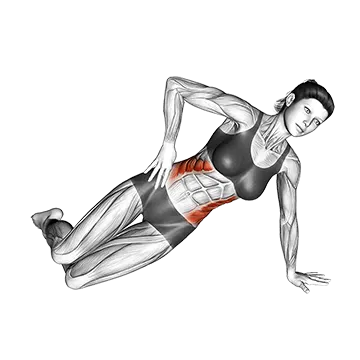
Standing Side Bend (VERSION 2)
- Músculo objetivo
- Obliques
- Músculos sinergistas
- Iliopsoas
- Equipamiento
- Body weight
- Parte del cuerpo
- Waist
- Tipo
- Strength
The Standing Side Bend (VERSION 2) is a bodyweight lateral-flexion exercise that directly targets the obliques while the iliopsoas assists in stabilizing the torso throughout the movement. Performed from a standing position with hands clasped behind the head, it develops lateral core strength and waist mobility. It fits well as a warm-up, cool-down, or accessory movement within any strength or conditioning session.
Cómo hacer el Standing Side Bend (VERSION 2)
- 1Stand tall with your feet hip-width apart, toes pointing forward, and your weight evenly distributed across both feet.
- 2Interlace your fingers and place both hands behind your head, elbows pointing out to the sides.
- 3Brace your core lightly, draw your shoulders down and back, and fix your gaze straight ahead.
- 4Keeping your hips square and your lower body still, exhale and slowly bend your torso directly to the right, sliding your right elbow toward your right hip.
- 5Lower only as far as you can without your hips shifting or your chest rotating — the movement is pure lateral flexion.
- 6Pause briefly at the bottom of the bend, feeling a stretch along the left side of your waist.
- 7Inhale and use your obliques to pull your torso back to the upright starting position.
- 8Complete all reps on the right side, then repeat the same number of reps bending to the left.
Consejos de técnica
- Keep both elbows flared wide and your head neutral throughout — do not pull your head forward with your hands.
- Move in a single plane: imagine you are sliding between two panes of glass — no forward lean, no rotation.
- Control the return as deliberately as the bend; the obliques on the opposite side are working hard on the way back up.
- Start with a small range of motion and increase depth only as long as your hips stay square and your spine stays long.
Errores comunes
- Letting the hips shift to one side to extend reach — this transfers the load away from the obliques and can compress the lumbar spine unevenly.
- Rotating the chest forward or backward instead of bending purely sideways, which takes the obliques out of the movement and strains the lower back.
- Pulling the head and neck with the hands rather than keeping the hands passive — this stresses the cervical spine.
- Rushing through the repetitions using momentum instead of controlled lateral flexion, which reduces oblique activation and increases injury risk.
Preguntas frecuentes
What muscles does the Standing Side Bend (VERSION 2) work?
The exercise primarily works the obliques (the muscles along the sides of your waist), with the iliopsoas acting as a synergist to help stabilize and control the movement.
What is the difference between VERSION 1 and VERSION 2 of the Standing Side Bend?
VERSION 2 is performed with both hands clasped behind the head, which keeps the arms from assisting the movement and places a slightly greater stability demand on the obliques compared to versions where one or both arms hang at the side.
Is the Standing Side Bend (VERSION 2) good for beginners?
Yes — it requires no equipment and is low-impact. Beginners should focus on keeping the hips square and using a modest range of motion before trying to bend deeper.
How many sets and reps should I do?
Two to three sets of 10–15 reps per side works well for most people. Because it is a bodyweight movement, higher rep ranges with slow, controlled tempo are more effective than rushing through low reps.
Where should I feel the Standing Side Bend (VERSION 2)?
You should feel a stretch and mild tension along the side of the waist opposite to your bend direction, and active contraction on the side you are bending toward. If you feel sharp lower-back pain, check that your hips are staying level and that you are not over-reaching.