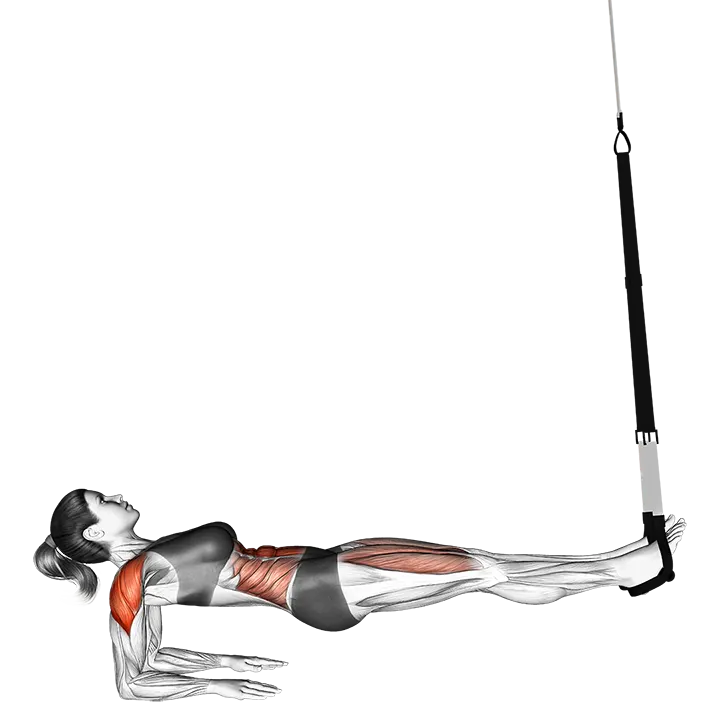
Suspension Supine Plank
- Músculo objetivo
- Deltoid Anterior, Deltoid Lateral, Rectus Abdominis
- Músculos sinergistas
- Obliques, Quadriceps
- Equipamiento
- Suspension
- Parte del cuerpo
- Waist
- Tipo
- Strength
The suspension supine plank is a shoulder- and core-intensive bodyweight exercise that primarily targets the anterior and lateral deltoids and the rectus abdominis, with the obliques and quadriceps working to keep your body rigid. Performed face-up with your feet secured in suspension strap cradles, it challenges your shoulders isometrically and builds core stability under load.
Cómo hacer el Suspension Supine Plank
- 1Set the suspension straps to a low position, roughly 6–12 inches off the floor, and place both feet into the foot cradles, resting your heels in the cradles with your toes pointing up.
- 2Sit on the floor beneath the straps, then lean back and extend your arms alongside your torso with your palms pressing down toward the ground.
- 3Drive through your hands and arms to lift your hips off the floor, forming a straight line from your shoulders to your heels.
- 4Keep your head neutral — do not let it drop back — and brace your core firmly throughout the hold.
- 5Squeeze your quadriceps to prevent your knees from bending and your obliques to resist any rotation or sagging at the hips.
- 6Hold the position for the target duration, breathing steadily without releasing tension in your shoulders or midsection.
- 7Lower your hips back to the floor with control to end the set.
Consejos de técnica
- Push your hands actively into the floor or toward the floor throughout the hold — passive arms will let your shoulders collapse and break the plank line.
- Think about keeping your body in one rigid plank: hips, knees, and shoulders should form a straight line, not a sagging or arched curve.
- Brace your obliques as if bracing for a punch — this is what resists rotation and keeps the strap handles from pulling your hips sideways.
- Start with short hold durations (10–15 seconds) and build up; losing form under fatigue shifts stress away from the target muscles and onto your spine.
Errores comunes
- Letting the hips sag toward the floor, which removes the load from the deltoids and places it on the lower back instead.
- Allowing the head to drop back excessively, which compresses the cervical spine and indicates a loss of full-body tension.
- Bending the knees during the hold, which shortens the lever and reduces the stabilizing demand on the quadriceps and obliques.
- Holding your breath, which spikes intra-abdominal pressure unnecessarily and leads to premature fatigue — breathe steadily throughout.
Preguntas frecuentes
What muscles does the suspension supine plank work?
It primarily targets the anterior and lateral deltoids, which work to maintain your arm position against gravity, along with the rectus abdominis holding your torso in line. The obliques and quadriceps act as synergists to keep your body rigid and prevent rotation or sag.
How is the suspension supine plank different from a regular floor plank?
In a standard plank you face down and bear weight through your forearms or hands on the floor. The suspension supine plank has you face up with your feet elevated in straps, placing a much greater isometric demand on the shoulders and increasing the instability challenge.
How long should I hold the suspension supine plank?
Beginners should aim for 10–20 second holds with strict form. As your shoulder and core strength improve, work up to 30–45 second holds or incorporate it into timed circuits.
Can I make the exercise harder or easier?
To make it easier, set the straps lower so your feet sit closer to floor height and you have less distance to lift your hips. To increase difficulty, raise the strap height, hold for longer, or add a small hip extension pulse during the hold.
Is the suspension supine plank suitable for beginners?
It requires a reasonable base of shoulder and core stability, so complete beginners may find it challenging. Build comfort with floor planks and basic shoulder exercises before attempting it.