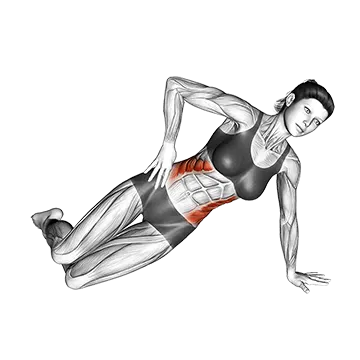
Twist Side Bridge
- Músculo objetivo
- Obliques
- Músculos sinergistas
- Adductor Brevis, Adductor Longus, Deltoid Anterior, Deltoid Posterior, Gluteus Medius, Iliopsoas, Pectineous, Rectus Abdominis, Sartorius, Tensor Fasciae Latae
- Equipamiento
- Body weight
- Parte del cuerpo
- Shoulders
- Tipo
- Strength
The Twist Side Bridge is a bodyweight strength exercise that targets the obliques by combining a side plank hold with a controlled rotational dip of the hips toward the floor. The anterior and posterior deltoid bear the load of the supporting arm, while the gluteus medius, rectus abdominis, tensor fasciae latae, iliopsoas, adductor brevis, adductor longus, pectineous, and sartorius all work to maintain alignment through each rotation. It is particularly effective for building lateral core stability and rotational strength without equipment.
Cómo hacer el Twist Side Bridge
- 1Lie on your right side and prop yourself on your right forearm, placing your elbow directly beneath your shoulder with your forearm pointing straight ahead.
- 2Stack your left foot on top of your right foot, keeping your body in a straight line from head to heels, and lift your hips off the floor into a full side plank.
- 3Brace your core and press your right shoulder away from your ear to engage the deltoid and stabilize the supporting arm.
- 4Take a breath in, then on the exhale begin rotating your torso by allowing your left hip to arc forward and downward toward the floor in a controlled, smooth motion.
- 5Lower your hips until they are just above the floor — do not let them make contact — keeping your feet stacked and your supporting elbow fixed in place.
- 6Pause briefly at the bottom of the rotation, feeling the obliques lengthen on the right side and contract on the left.
- 7Exhale and reverse the motion, rotating your hips back up and through the starting side plank position to complete one repetition.
- 8Complete all reps on the right side, then reposition and repeat with the left forearm on the floor.
Consejos de técnica
- Keep your supporting elbow directly under your shoulder for the entire set — letting it drift forward reduces deltoid stability and puts unnecessary stress on the wrist and elbow.
- Drive the rotation from your hips, not your lower back; think of your pelvis arcing in a smooth half-circle rather than simply sagging toward the floor.
- Keep your top hand resting on your hip or extended toward the ceiling — placing it on the floor in front of you turns the movement into a push-up assist and removes oblique load.
- Control the descent with the same intention as the return — lowering slowly under tension produces more oblique work than dropping and bouncing back up.
- If balance is difficult, stagger your feet by placing the top foot slightly in front of the bottom foot to widen your base without changing the rotational demand.
Errores comunes
- Letting the hips sag in the side plank position before starting the rotation — beginning from a sagged plank means the obliques are already disengaged, and the twist produces little additional training stimulus.
- Allowing the bottom shoulder to collapse inward during the twist, which compresses the shoulder joint and shifts load off the deltoid onto passive structures in the rotator cuff.
- Rotating so far that the hips touch the floor and momentum carries them back up — contact removes tension from the obliques at the critical bottom position and turns the rep into a bounce.
- Tilting the head down or craning the neck to look at the floor during the dip, which disrupts spinal alignment and can cause neck strain over high-rep sets.
- Rushing through reps by using hip momentum rather than muscular control, which reduces time under tension for the obliques and the stabilizing work demanded of the gluteus medius and tensor fasciae latae.
Preguntas frecuentes
What muscles does the Twist Side Bridge work?
The primary muscle is the obliques. Synergists include the anterior and posterior deltoid (supporting arm), gluteus medius, rectus abdominis, tensor fasciae latae, iliopsoas, adductor brevis, adductor longus, pectineous, and sartorius, all of which stabilize the hips and legs throughout the movement.
What is the difference between a Twist Side Bridge and a standard side plank?
A standard side plank is an isometric hold, while the Twist Side Bridge adds a dynamic hip rotation that takes the obliques through a full range of motion. The rotational component increases the demand on the obliques and also recruits the iliopsoas, adductors, and sartorius more actively than a static hold.
Is the Twist Side Bridge suitable for beginners?
It is best suited to those who can already hold a solid side plank for 20–30 seconds, since the rotation adds a coordination and stability challenge on top of the base position. Beginners should build the static side plank first, then progress to the twist once the supporting shoulder and core feel stable.
How many sets and reps should I do for the Twist Side Bridge?
Two to three sets of 10–15 repetitions per side is a practical range for most people. Because the obliques are being taken through a full rotational arc under load, prioritize slow, controlled reps over high volume, especially when learning the movement.
Where should I feel the Twist Side Bridge?
You should feel the primary work in the obliques on both sides — the lower side contracts isometrically to support the plank while the upper side controls the rotation. A steady burn in the outer shoulder (deltoid) of the supporting arm and mild activation in the outer hip (gluteus medius) are also normal.