Wrist Push-up
- Músculo objetivo

- Wrist Extensors, Wrist Flexors
- Equipamiento
- Body weight
- Parte del cuerpo
- Forearms
- Tipo
- Strength
The wrist push-up is a bodyweight forearm exercise performed on the backs of the hands, directly loading the wrist extensors and wrist flexors through their full range of motion. Commonly used in martial arts training and rehabilitation, it builds grip-independent wrist strength and resilience that standard push-up variations cannot replicate.
Cómo hacer el Wrist Push-up

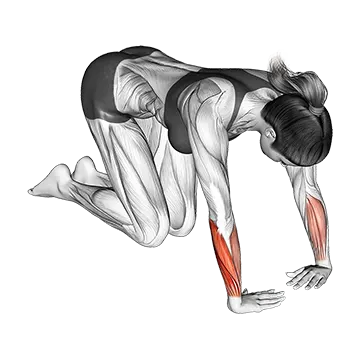
- 1Start on all fours on a padded or carpeted surface. Flip both hands over so the backs of your hands rest flat on the floor with your fingers pointing toward your knees.

- 2Walk your knees back or straighten your legs into a full push-up position, keeping your hands directly beneath your shoulders and your body forming a straight line from head to heels.
- 3Brace your core and squeeze your glutes to prevent your hips from sagging or piking.
- 4Inhale and bend your elbows to lower your chest toward the floor at a controlled pace, keeping your elbows at roughly a 45° angle to your torso.
- 5Descend until your chest is a few inches from the floor or until you feel a deep stretch across the backs of your forearms — whichever comes first.
- 6Exhale and press firmly through the backs of your hands to push your body back up to the starting position, fully extending your elbows.
- 7Pause briefly at the top, check your alignment, and repeat for the desired number of reps.
- 8To finish, lower your knees to the floor first, then return your hands to a neutral position and gently rotate your wrists in both directions to release tension.
Consejos de técnica
- Begin on your knees rather than in a full push-up position until the stretch and load on your wrists feels manageable — wrist extensors are rarely trained this way and need time to adapt.
- Press the entire dorsal surface of each hand into the floor evenly; avoid rolling onto the knuckles or the pinky edge, which concentrates stress on one side of the joint.
- Move slowly — a 3-second descent amplifies the eccentric load on the wrist extensors and builds strength faster than rushing through reps.
- Warm up your wrists with gentle circles and passive wrist flexion stretches before each set to reduce injury risk.
- Stop the set if you feel sharp pain rather than a muscular burn; a strong stretch in the forearm extensors is normal, but joint pain is a signal to reduce range of motion or load.
Errores comunes
- Skipping a wrist warm-up before the first set, which increases the risk of strain because the wrist extensors are typically undertrained and have limited loading tolerance without preparation.
- Allowing the hips to sag toward the floor, which shifts effort away from the forearms and places unwanted stress on the lower back.
- Rushing the descent by dropping quickly, which sacrifices the eccentric loading phase where most of the wrist extensor stimulus occurs.
- Placing the hands too far forward of the shoulders, which levers excessive torque onto the wrist joint rather than distributing load through the forearm musculature.
- Progressing to full push-up range of motion too soon — pushing through wrist pain rather than staying at a shallower depth builds bad tolerance patterns and risks acute injury.
Preguntas frecuentes
What muscles does the wrist push-up work?
The wrist push-up targets the wrist extensors and wrist flexors of the forearm. Because the hands are inverted, the extensors are loaded through a stretched position during the descent, making it one of the few bodyweight exercises that directly trains this muscle group.
Is the wrist push-up safe for beginners?
It can be, provided you start on your knees, use a padded surface, warm up thoroughly, and keep the range of motion shallow at first. The wrist extensors are not accustomed to this type of load, so progress gradually — expect some forearm fatigue and mild discomfort, but stop if you feel sharp joint pain.
How is a wrist push-up different from a knuckle push-up?
A knuckle push-up is performed on the front of the knuckles with the palm facing down, which mainly removes wrist extension strain. A wrist push-up is performed on the back of the hands with the palm facing up, actively loading the wrist extensors and flexors throughout the movement.
How many reps should I do?
Because this is an isolation exercise for a small, often undertrained muscle group, start with 2–3 sets of 5–8 reps on your knees. As your wrist extensors adapt over several weeks, progress to higher reps or the full push-up position before adding any external load.