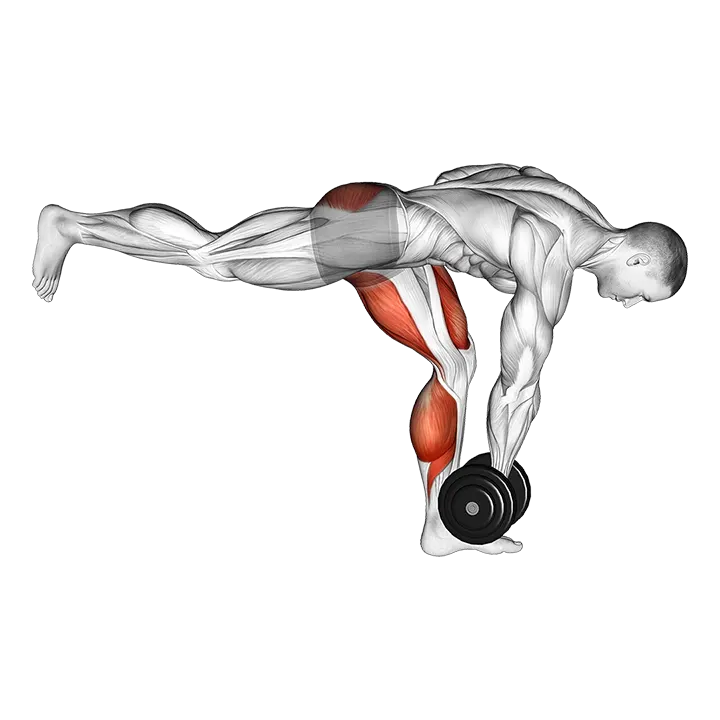
Dumbbell RDL Stretch Isometric
- Equipment
- Dumbbell
- Körperregion
- Hips
- Typ
- Stretching


The dumbbell RDL stretch isometric is a Romanian deadlift held statically at the bottom stretched position to load the posterior chain under tension. Holding dumbbells, you hinge at the hips and pause at the point of deepest stretch, where it challenges the glutes (gluteus maximus), inner thigh (adductor magnus), quads, and calves (gastrocnemius and soleus). It builds hip-hinge control and stretch tolerance rather than reps.
Dumbbell RDL Stretch Isometric: So führst du sie aus
- 1Stand tall holding a dumbbell in each hand at the front of your thighs, feet about hip-width apart with a soft bend in your knees.
- 2Brace your core and pull your shoulder blades down and back so the dumbbells stay close to your legs.
- 3Push your hips straight back and hinge forward, letting the dumbbells travel down the front of your shins while keeping your back flat.
- 4Descend slowly until you feel a strong stretch through your hamstrings and glutes, stopping before your lower back starts to round.
- 5Hold this bottom stretched position statically, keeping the dumbbells close to your legs and your spine neutral.
- 6Maintain steady, controlled breathing and keep tension through your hips, inner thighs, and calves for the full hold time.
- 7When the hold is complete, drive your hips forward and stand tall to finish, then set the dumbbells down with control.
Technik-Tipps
- Keep a flat, neutral spine throughout the hold — think of pushing your hips toward the wall behind you rather than bending your back.
- Keep the dumbbells tracking close to your legs to keep the load over your hips and reduce strain on your lower back.
- Stop the descent at the point of a strong but controlled stretch; depth should come from your hip hinge, not from rounding forward.
- Start with light dumbbells and short holds, then add time or load only once you can keep a flat back for the whole hold.
Häufige Fehler

- Rounding the lower back at the bottom, which shifts the stretch onto the spine and raises the risk of injury.
- Bending the knees too much, which turns the hinge into a squat and takes tension off the hamstrings and glutes.
- Letting the dumbbells drift forward away from the legs, which overloads the lower back and breaks the hinge position.
- Holding your breath and losing core bracing, which makes the spine less stable under the stretched load.
- Going deeper than your mobility allows, which forces the back to round to reach the bottom.
Häufig gestellte Fragen
What muscles does the dumbbell RDL stretch isometric work?
The static stretched hold loads the glutes (gluteus maximus), inner thigh (adductor magnus), and quadriceps, along with the calves (gastrocnemius and soleus). It emphasizes the posterior chain under a deep hip-hinge stretch.
How long should I hold the bottom position?
Treat it as a timed hold rather than reps. Beginners can start with 15–20 second holds for 2–3 sets, building toward 30–45 seconds as your hinge control and stretch tolerance improve.
Where should I feel this exercise?
You should feel a strong stretch through your hamstrings and glutes at the bottom, with the inner thighs and calves also under tension. You should not feel it as strain in your lower back.
Is the dumbbell RDL stretch isometric good for beginners?
Yes, with light dumbbells and a shallow hinge. It is a useful way to learn the hip-hinge pattern and build posterior-chain stretch tolerance before progressing to heavier Romanian deadlifts.