
Exercise Ball Alternating Arm Ups
- Zielmuskel
- Latissimus Dorsi
- Synergistenmuskeln
- Deltoid Posterior, Obliques
- Equipment
- Stability ball
- Körperregion
- Back
- Typ
- Strength

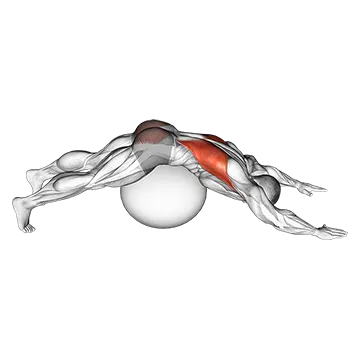






The exercise ball alternating arm ups is a bodyweight back exercise that targets the latissimus dorsi while you balance face-down over a stability ball. Raising one arm overhead at a time also recruits the rear deltoids and challenges the obliques to resist rotation, making it a useful move for upper-back strength and core stability.
Exercise Ball Alternating Arm Ups: So führst du sie aus
- 1Kneel behind a stability ball and lean forward so the ball supports your stomach and hips, with your body in a straight line from head to knees.
- 2Walk your hands out until your weight is balanced and your arms hang down toward the floor in front of you.
- 3Brace your core and squeeze your glutes so your hips and shoulders stay level and the ball does not roll.
- 4Keeping a slight bend in the elbow, raise one arm forward and overhead until it is roughly in line with your torso.
- 5Squeeze your lat and rear shoulder at the top, keeping your hips square and resisting any twist toward the lifting side.
- 6Lower the arm under control back to the start without letting the ball shift.
- 7Repeat with the opposite arm, alternating sides for the desired number of reps.
- 8Finish by walking your hands back in and lowering your knees to step off the ball safely.
Technik-Tipps
- Move slowly and deliberately — control matters more than range, and rushing causes the ball to wobble and rob tension from the lats.
- Keep your neck long and your gaze down at the floor so your spine stays neutral throughout the set.
- Lead the lift with your elbow and shoulder blade rather than your hand, so the back muscles do the work instead of the arm.
- Actively fight rotation: imagine balancing a glass of water on your lower back as each arm rises.
- Set the ball against a wall or use a slightly deflated ball if balance is difficult when you start out.
Häufige Fehler
- Letting the hips twist toward the working arm, which removes the anti-rotation challenge from the obliques and shifts the load off the target muscles.
- Shrugging the shoulder up toward the ear instead of driving the arm from the lat, which builds tension in the neck and traps.
- Arching or rounding the lower back to gain extra reach, placing unnecessary strain on the spine.
- Swinging the arm up with momentum, which lets the ball roll and reduces the work on the lats and rear delts.
- Holding your breath while balancing, which makes it harder to stay braced and stable.
Häufig gestellte Fragen
What muscles do exercise ball alternating arm ups work?
They primarily work the latissimus dorsi (lats), with the posterior deltoids and obliques assisting. The obliques work isometrically to resist rotation as each arm lifts.
Are exercise ball alternating arm ups good for beginners?
Yes. They use only your bodyweight and a stability ball, so the load is light and joint-friendly. Beginners can rest the ball against a wall for extra stability while learning to balance.
How many sets and reps should I do?
Aim for 2–3 sets of 8–12 reps per arm. Because the focus is control and stability rather than heavy load, prioritize smooth, balanced reps over high numbers.
Where should I feel this exercise?
You should feel it mainly across your back below the shoulder blade (the lat) and in the back of the shoulder, with your core and obliques working to keep your hips from twisting.