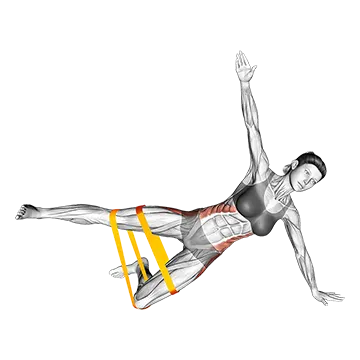
Resistance Band Bent Leg Side Kick (kneeling)
- Zielmuskel
- Gluteus Medius
- Synergistenmuskeln
- Obliques, Tensor Fasciae Latae
- Equipment
- Resistance Band
- Körperregion
- Hips
- Typ
- Strength
The Resistance Band Bent Leg Side Kick (kneeling) is a kneeling hip abduction exercise that targets the gluteus medius by driving the bent working leg out to the side against band resistance. The obliques and tensor fasciae latae work throughout to stabilize the pelvis and keep the hips level. It is well suited for building lateral hip strength, correcting glute medius weakness, and adding load to an otherwise bodyweight-only movement.
Resistance Band Bent Leg Side Kick (kneeling): So führst du sie aus
- 1Loop a resistance band around both thighs just above the knees, or around the ankles for greater challenge.
- 2Position yourself on all fours with your hands directly under your shoulders and your knees directly under your hips, keeping a neutral spine.
- 3Brace your core and press the non-working knee and both hands firmly into the floor to create a stable base.
- 4Keeping your working knee bent at roughly 90 degrees, raise that leg out to the side in a smooth arc until your thigh is parallel to the floor or slightly above, without rotating the hip open.
- 5Pause briefly at the top, feeling the contraction in the outer hip of the working leg.
- 6Lower the knee back toward the starting position in a controlled manner, resisting the pull of the band on the way down.
- 7Complete all reps on one side before switching to the other leg.
Technik-Tipps
- Keep your hips square to the floor throughout the movement — if one hip hikes up, you have exceeded your range of motion or are compensating with the lower back.
- Focus on driving the movement from the outer hip rather than rotating the foot toward the ceiling, which would shift effort away from the gluteus medius.
- Maintain a neutral wrist and elbow position in the supporting arm to avoid loading the joints unnecessarily during longer sets.
- Choose a band tension that allows smooth, full-range reps; a band that is too heavy will cause you to compensate with trunk rotation before you reach parallel.
Häufige Fehler
- Letting the hip hike on the working side: elevating the pelvis recruits the quadratus lumborum and lower back rather than the gluteus medius, reducing the effectiveness of the exercise and stressing the lumbar spine.
- Rotating the knee outward and pointing the foot at the ceiling: this turns the movement into external hip rotation rather than pure abduction, taking tension off the gluteus medius and placing it on different fibers and stabilizers.
- Allowing the lower back to sag or arch: a collapsed or over-arched spine destabilizes the core base, reducing the obliques' ability to hold the pelvis steady and increasing injury risk.
- Using momentum to swing the leg up: a fast, swinging rep bypasses the slow-twitch stabilizing fibers of the gluteus medius that the exercise is designed to target.
- Placing the band too low on the ankle without sufficient strength: this increases lever arm length abruptly and often leads to form breakdown before the glute medius is fatigued — start with the band above the knee and progress from there.
Häufig gestellte Fragen
What muscles does the resistance band bent leg side kick kneeling work?
The primary target is the gluteus medius, the main hip abductor that sits on the outer surface of the pelvis. The obliques and tensor fasciae latae act as synergists, stabilizing the pelvis and hip throughout the movement.
Where should I place the resistance band — above the knee or at the ankle?
Placing the band just above the knees shortens the lever arm and makes the exercise more manageable, which is the best starting point. Moving the band to the ankles increases the resistance moment and is appropriate once you can perform clean reps with the band above the knee.
How high should I lift my leg during the side kick?
Aim to bring the thigh to roughly parallel with the floor — approximately hip height. Going higher typically causes the hip to rotate open or the pelvis to tilt, shifting the load away from the gluteus medius.
How many reps and sets should I do?
Two to three sets of 12–15 reps per side is a practical starting range for most people. Rest 30–45 seconds between sides and prioritize full range of motion over high rep counts.
Can this exercise help with knee or lower back pain caused by weak hips?
A weak gluteus medius is commonly associated with poor pelvic control, which can contribute to knee tracking issues and lower back overload. Strengthening the glute medius through exercises like this one can support better alignment, but consult a healthcare professional before using exercise to address existing pain.