
Resistance Band Clam
- Zielmuskel
- Gluteus Medius
- Synergistenmuskeln
- Tensor Fasciae Latae
- Equipment
- Resistance Band
- Körperregion
- Hips
- Typ
- Strength
The Resistance Band Clam is a side-lying hip exercise that places a resistance band just above the knees and has you rotate the top knee upward against that tension, directly targeting the gluteus medius. The tensor fasciae latae assists with hip abduction throughout the movement. It is particularly effective for glute activation, correcting knee-tracking issues, and hip rehabilitation.
Resistance Band Clam: So führst du sie aus
- 1Loop a resistance band around both legs just above the knees.
- 2Lie on your side on a mat with your hips stacked directly on top of each other and your body in a straight line from head to feet.
- 3Bend both knees to approximately 45 degrees, keeping your feet stacked together and your feet in line with your hips.
- 4Rest your bottom arm on the mat and place your top hand on your hip or the floor in front of you for balance.
- 5Brace your core lightly so your hips remain stable and do not rock backward during the movement.
- 6Keeping your feet pressed together, slowly rotate your top knee upward toward the ceiling as far as you can without your pelvis tilting or rolling back.
- 7Pause briefly at the top of the movement when you feel a contraction in the outer hip.
- 8Lower your top knee back down with control until your legs are stacked again.
- 9Complete all reps on one side before rolling over and repeating on the other side.
Technik-Tipps
- Keep your hips stacked throughout the set — the moment your pelvis rotates backward to gain extra range, the gluteus medius loses tension and the lower back takes over.
- Imagine your feet as a hinge point: they stay fixed together while only the knee opens, which keeps the movement isolated to hip abduction and external rotation.
- Choose a band resistance that lets you achieve full range of motion with control; if your hip hikes or your torso twists to complete the rep, the band is too heavy.
- Move at a deliberate tempo — about two seconds up and two seconds down — rather than letting the band snap your knee back down.
- If you feel the movement in your lower back rather than your outer hip, reduce the range of motion slightly and focus on keeping the core braced before adding range back in.
Häufige Fehler
- Rolling the pelvis backward to lift the knee higher: this substitutes lumbar rotation for hip abduction and shifts the work away from the gluteus medius, reducing the effectiveness of the exercise.
- Letting the feet separate: lifting both the knee and the foot turns the movement into a general hip rotation rather than a controlled abduction, dispersing the load and reducing glute engagement.
- Using too much band resistance: excess tension forces compensatory movements such as hip tilting or torso rotation, which undermine the isolation this exercise is designed to provide.
- Rushing through repetitions: a fast tempo allows the elastic recoil of the band to pull the knee back down, removing the eccentric load on the gluteus medius that builds strength.
- Neglecting the pause at the top: skipping the brief hold at peak contraction reduces total time under tension and limits the activation signal to the gluteus medius.
Häufig gestellte Fragen
What muscles does the resistance band clam work?
The primary muscle is the gluteus medius, which drives hip abduction and external rotation as the top knee lifts against the band. The tensor fasciae latae assists throughout the movement.
What resistance band strength should I use for clams?
Start with a light band that allows you to complete 12–15 reps per side with full range of motion and no pelvic tilt. Progress to a medium band only when you can maintain perfect hip stability throughout the set.
How is the resistance band clam different from a regular bodyweight clam?
Adding a resistance band creates progressive tension as the knee lifts, increasing the load on the gluteus medius in a way that bodyweight alone cannot. The band also provides tactile feedback, making it easier to feel whether you are actually working the outer hip.
Can the resistance band clam help with knee pain?
A weak gluteus medius is a common contributor to knee-tracking problems such as valgus collapse during squats and walking. Strengthening it with the clam can improve hip control and reduce medial knee stress, but you should consult a healthcare professional before using exercise to address an existing knee condition.
How many sets and reps should I do?
Two to three sets of 12–20 reps per side works well for most purposes, whether the goal is activation before a lower-body workout or general hip strengthening. Rest 30–60 seconds between sides and prioritize quality of movement over rep count.
Ähnliche Übungen
 Resistance Band Bent Leg Side Kick (kneeling)Hips
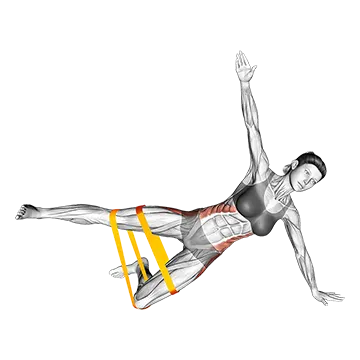 Resistance Band Kneeling Side PlankHips
 Resistance Band Lying AbductionHips
 Resistance Band Lying Leg RaiseHips
 Resistance Band Seated Hip AbductionHips
 Band Cross AbductionHips
 Band Hip AbductionHips
 Band horizontal Pallof Press with Resistance Band SquatHips, Thighs, Waist