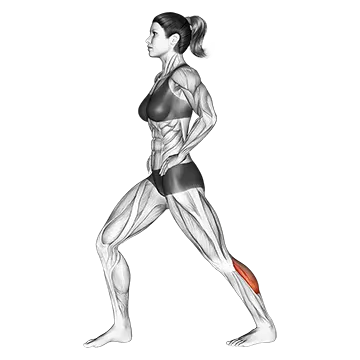
Standing Calf Raise
- Zielmuskel
- Gastrocnemius
- Synergistenmuskeln
- Soleus
- Equipment
- Body weight
- Körperregion
- Calves
- Typ
- Strength
The standing calf raise is a fundamental lower-leg strength exercise that primarily targets the gastrocnemius, the large two-headed muscle that gives the calf its shape, with the soleus acting as a key synergist. Performed upright using only body weight, it builds ankle stability, lower-leg endurance, and explosive pushing power for running, jumping, and everyday movement.
Standing Calf Raise: So führst du sie aus
- 1Stand with your feet hip-width apart and your toes pointing straight ahead, near a wall or sturdy surface you can lightly touch for balance.
- 2Distribute your weight evenly across both feet and engage your core to keep your torso upright throughout the movement.
- 3Press through the balls of your feet and raise your heels as high as possible, fully contracting the calves at the top.
- 4Hold the top position for one count, squeezing the calves.
- 5Lower your heels slowly and under control until you feel a full stretch through the calves — heels at or just below floor level if using a raised surface.
- 6Pause briefly at the bottom to eliminate momentum, then begin the next rep.
- 7Complete all reps while keeping your knees straight but not locked out.
Technik-Tipps
- Perform the lowering phase slowly — taking 2–3 seconds on the way down — to maximise time under tension and achieve full range of motion through the gastrocnemius.
- Rise as high as possible onto the balls of your feet on every rep; a shortened range of motion limits calf development and reduces the stretch reflex benefit.
- Lightly touch a wall or rack only for balance — avoid gripping or pushing off it, as this transfers load away from the calves.
- Keep your knees straight throughout to keep the gastrocnemius under tension; bending the knees shifts emphasis to the soleus.
- Breathe out as you rise and breathe in as you lower to maintain steady rhythm and intra-abdominal pressure.
Häufige Fehler
- Bouncing at the bottom of the rep — using elastic rebound instead of a controlled descent eliminates the loaded stretch and reduces calf activation.
- Not rising high enough — stopping short of full plantar flexion cuts the range of motion and under-stimulates the gastrocnemius.
- Letting the ankles roll outward or inward — pronation or supination distributes load unevenly and can strain the ankle joint over time.
- Going too fast — rushing through reps turns the exercise into a momentum drill rather than a controlled strength movement, reducing muscle tension.
- Holding on too tightly for balance — gripping a support and leaning into it offloads the calves and defeats the stabilisation benefit of the exercise.
Häufig gestellte Fragen
What is the difference between the gastrocnemius and the soleus, and how does the standing calf raise target each?
The gastrocnemius is the large, visible two-headed muscle that crosses both the knee and ankle joints, while the soleus lies beneath it and crosses only the ankle. Because the standing calf raise is performed with straight knees, the gastrocnemius is fully lengthened and carries most of the load. The soleus assists but is more heavily recruited when the knee is bent (as in a seated calf raise).
How many reps should I do for calf raises?
Calves respond well to a wide rep range. For strength and hypertrophy, sets of 8–15 reps with a slow, controlled tempo and full range of motion are effective. For endurance and stability, higher rep sets of 15–30 also work well. The key is reaching close to muscular failure within the chosen range while maintaining strict form.
Can I make body-weight standing calf raises harder without adding equipment?
Yes — several progressions increase difficulty without equipment. Perform single-leg calf raises to double the load per leg and add a balance challenge. You can also slow the lowering phase to 3–5 seconds, add a pause at the bottom, or stand on the edge of a step to increase the range of motion and stretch depth.
Why do my calves seem to stop growing even though I train them consistently?
Calves are highly fatigue-resistant and accustomed to low-grade loading from walking all day. Common reasons for a plateau include using too short a range of motion, relying on momentum, not achieving sufficient tension at the top, or not progressing difficulty over time. Slow the tempo, maximise range of motion, and consider single-leg variations to overcome stagnation.
Is it better to do calf raises with feet parallel, toes in, or toes out?
A parallel (neutral) foot position is the standard starting point and evenly loads the calf. Angling the toes slightly outward may emphasise the inner head of the gastrocnemius, while angling them inward may shift focus to the outer head. However, these effects are modest, and most people benefit most from mastering the neutral position with full range of motion before experimenting.