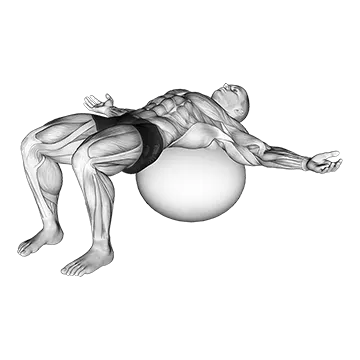
Gewichtete Hyperextension auf dem Gymnastikball
- Zielmuskel
- Erector Spinae
- Equipment
- Weighted
- Körperregion
- Waist
- Typ
- Strength



Die gewichtete Hyperextension auf dem Gymnastikball ist eine Übung zur Stärkung des unteren Rückens, die den Musculus erector spinae (Rückenstrecker) durch einen vollen Bewegungsumfang der Wirbelsäule trainiert. Das Halten einer Gewichtsscheibe oder Kurzhantel vor der Brust erhöht die Last, während die instabile Unterlage dazu führt, dass deine Hüften und dein Core arbeiten müssen, um bei jeder Wiederholung das Gleichgewicht zu halten. Sie eignet sich für Trainierende, die die Kraft und Ausdauer des unteren Rückens mit zusätzlicher Last steigern wollen.
Gewichtete Hyperextension auf dem Gymnastikball: So führst du sie aus
- 1Platziere einen Gymnastikball auf dem Boden und positioniere deine Hüften sowie deinen unteren Bauch darauf, mit dem Gesicht nach unten. Gehe mit den Füßen so weit zurück, bis sie etwa hüftbreit stehen, wobei deine Zehen für mehr Stabilität fest in den Boden gedrückt werden.
- 2Halte eine Gewichtsscheibe oder Kurzhantel mit beiden Händen vor deiner Brust. Halte das Gewicht während der gesamten Bewegung nah an deinem Körper.
- 3Beginne mit nach unten geneigtem Oberkörper, sodass dein Oberkörper natürlich über der Vorderseite des Balls hängt und deine Wirbelschaul in einer neutralen Position ist.
- 4Spanne deine Gesäßmuskulatur an und aktiviere deinen unteren Rücken, um deinen Oberkörper anzuheben, bis dein Körper eine gerade Linie von den Fersen bis zum Kopf bildet – überstrecke den Rücken nicht über die neutrale Position hinaus.
- 5Halte die Spannung am höchsten Punkt für eine Sekunde, während der Musculus erector spinae (Rückenstrecker) vollständig kontrahiert ist.
- 6Senke deinen Oberkörper langsam und kontrolliert über 2–3 Sekunden wieder in die Ausgangsposition ab.
- 7Führe alle Wiederholungen durch, ohne die Spannung am tiefsten Punkt zu verlieren – halte den unteren Rücken während des gesamten Satzes leicht angespannt.
Technik-Tipps
- Drücke das Gewicht fest gegen deine Brust, damit es nicht nach vorne rutscht und dich auf dem Ball aus dem Gleichgewicht bringt.
- Konzentriere dich darauf, die Bewegung über den unteren Rücken und die Hüfte auszuführen, anstatt deine Schultern ruckartig nach oben zu bewegen – die Aufwärtsbewegung sollte von Anfang bis Ende kontrolliert sein.
- Drücke deine Füße während des gesamten Satzes in den Boden, um deine Position auf dem Ball zu verankern und ein Wegrollen zu verhindern.
- Beginne mit einer leichten Gewichtsscheibe, bis du dich beim Balancieren auf dem Ball sicher fühlst, bevor du zu schwereren Lasten übergehst.
Häufige Fehler
- Überstrecken des unteren Rückens am höchsten Punkt der Wiederholung, was die Lendenwirbel komprimiert und das Verletzungsrisiko unter Last erhöht.
- Nutzung von Schwung beim Hochschwingen des Oberkörpers anstatt einer kontrollierten Hebung durch den Musculus erector spinae, was die Muskelaktivierung verringert und den Ball destabilisiert.
- Halten des Gewichts zu weit vom Körper entfernt, wodurch sich der Schwerpunkt nach vorne verschiemt und das Gleichgewicht auf dem Ball schwerer zu halten ist.
- Rundung des oberen Rückens beim Hochgehen, was die Spannung vom Musculus erector spinae nimmt und Stress auf die Brustwirbelsäule ausübt.
- Auslassen der Pause am höchsten Punkt, was die Kontraktion des Musculus erector spinae verkürzt und den Trainingsreiz verringert.
Häufig gestellte Fragen
Welche Muskeln werden bei der gewichteten Hyperextension auf dem Ball trainiert?
Sie zielt primär auf den Musculus erector spinae (Rückenstrecker) ab – die Muskelgruppe, die an beiden Seiten der Wirbelsäule verläuft und für die Streckung sowie Stabilisierung des unteren Rückens verantwortlich ist.
Wie unterscheidet sich dies von einer Hyperextension an der römischen Bank?
Der Gymnastikball ersetzt die feste Hüftstütze der römischen Bank, sodass dein Core und deine Hüften härter arbeiten müssen, um bei jeder Wiederholung das Gleichgewicht zu halten. Dies macht die Bewegung weniger stabil und begrenzt im Allgemeinen die Menge des einsetzbaren Gewichts.
Mit welchem Gewicht sollte ich beginnen?
Beginne mit einer leichten Scheibe (5 bis 10 lb), um die Balanceanforderungen des Balls kennenzulernen, bevor du mehr Last hinzufügst. Erhöhe das Gewicht erst, wenn du alle Wiederholungen mit kontrollierter Form und stabiler Position durchführen kannst.
Wie viele Wiederholungen sollte ich machen?
Sätze von 8–15 Wiederholungen eignen sich gut zum Aufbau von Kraft und Ausdauer im unteren Rücken. Wähle bei schwererem Gewicht eher den unteren Bereich der Wiederholungszahl und priorisiere die Kontrolle vor dem Volumen.
Ist diese Übung sicher bei Rückenschmerzen?
Wenn du eine Vorgeschichte von Rückenproblemen hast, konsultiere einen Arzt, bevor du Lasten bei Bewegungen der Wirbelsäulenstreckung hinzufügst. Die gewichtete Version auf einer instabilen Unterlage ist eine fortgeschrittene Variation und wird während akuter Schmerzen oder in der Rehabilitation nicht empfohlen.