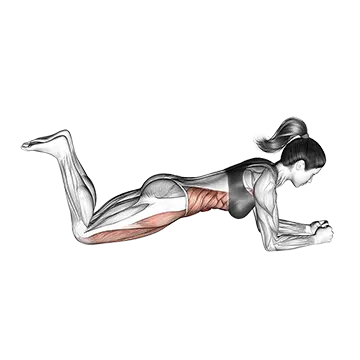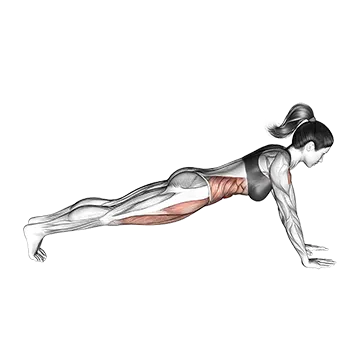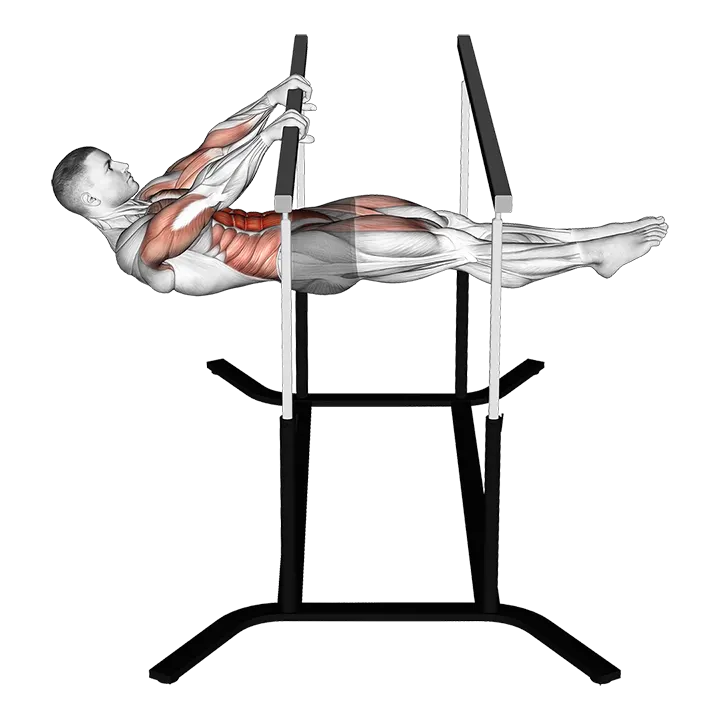
Front Lever
- Músculo objetivo
- Rectus Abdominis
- Músculos sinergistas
- Biceps Brachii, Brachialis, Brachioradialis, Iliopsoas, Obliques, Pectoralis Major Clavicular Head, Pectoralis Major Sternal Head, Quadriceps, Tensor Fasciae Latae, Triceps Brachii
- Equipamiento
- Body weight
- Parte del cuerpo
- Waist
- Tipo
- Strength
The front lever is an advanced bodyweight hold in which you hang from a bar and hold your body straight and horizontal, facing up. It is driven by the abs (rectus abdominis) and obliques to keep the torso rigid, with the biceps, forearms (brachialis, brachioradialis), chest, and triceps controlling the straight arms, plus the hip flexors and quads holding the legs locked. It builds elite core and straight-arm pulling strength for calisthenics and gymnastics.
Cómo hacer el Front Lever
- 1Grip a pull-up bar with an overhand (pronated) grip slightly wider than shoulder-width and hang with your arms straight.
- 2Brace your core hard, depress and retract your shoulder blades, and keep your arms locked straight throughout — power comes from the shoulders and back, not bent elbows.
- 3Pull the bar toward your hips as you lean your torso back, letting your body rotate up around the bar.
- 4Squeeze your glutes, quads, and abs to lock your hips, knees, and ankles into one rigid line from shoulders to toes.
- 5Raise your legs and lower your chest until your whole body is horizontal and facing the ceiling, parallel to the floor.
- 6Hold the straight-body position for time, keeping your hips level and resisting any sag at the hips or shoulders.
- 7Lower under control by reversing the motion until you return to a dead hang, then release the bar.
Consejos de técnica
- Keep your arms completely straight — bending the elbows turns it into a different movement and removes the straight-arm strength demand.
- Drive your shoulder blades down and away from your ears to protect the shoulders and create a stable base to lever from.
- Brace your abs as if bracing for a punch and tuck your ribs down to stop your lower back from arching.
- Build up through progressions — tuck lever, then advanced tuck, then one leg extended, then straddle — before attempting the full lever.
- Train over a soft surface or mat and stop the set the moment your form breaks rather than fighting a sagging position.
Errores comunes
- Bending the elbows to muscle the body up, which shifts load off the lats and core and changes the exercise entirely.
- Letting the hips sag below the line of the shoulders, which loses the straight-body tension and shortens the effective lever.
- Arching the lower back and flaring the ribs, which strains the spine and signals the abs aren't bracing hard enough.
- Shrugging the shoulders up toward the ears instead of depressing them, leaving the shoulder joint exposed and unstable.
- Jumping straight to the full lever before mastering the tuck and straddle progressions, which usually means broken form and stalled progress.
Preguntas frecuentes
What muscles does the front lever work?
It primarily works the abs (rectus abdominis), which keep the torso rigid, with the obliques, biceps, forearms (brachialis and brachioradialis), chest, triceps, hip flexors (iliopsoas), and quads working as synergists to hold the straight-arm, straight-body position.
How do you progress to a full front lever?
Work through easier holds in order: tuck lever, advanced tuck, single-leg extended, then straddle, and finally the full straight-body lever. Move on only once you can hold each variation cleanly for several seconds.
Is the front lever good for beginners?
No — it is an advanced movement that needs significant core and straight-arm pulling strength. Beginners should first build pull-ups and hanging leg raises, then start with the tucked front lever progression.
Why should my arms stay straight in a front lever?
Straight arms are what make it a lever: they force the lats, abs, and shoulders to support the load. Bending the elbows offloads that demand and turns it into a different, easier exercise.