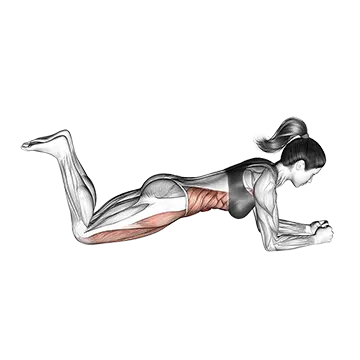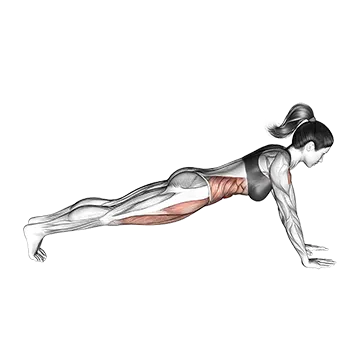
Front Plank
- Músculo objetivo
- Rectus Abdominis
- Músculos sinergistas
- Deltoid Anterior, Gluteus Maximus, Gluteus Medius, Obliques, Sartorius, Tensor Fasciae Latae
- Equipamiento
- Body weight
- Parte del cuerpo
- Waist
- Tipo
- Strength
The front plank is an isometric bodyweight core hold performed on your forearms that primarily targets the rectus abdominis (the abs), with strong assistance from the front shoulders (deltoid anterior), the glutes (gluteus maximus and medius), the obliques, and the hip flexors (sartorius and tensor fasciae latae). It builds whole-body bracing and trunk stability with no equipment needed.
Cómo hacer el Front Plank
- 1Kneel on the floor and place your forearms flat on the ground, elbows directly under your shoulders and forearms parallel, about shoulder-width apart.
- 2Step or extend your legs back so you are balanced on your forearms and toes, feet roughly hip-width apart.
- 3Set your body in a straight line from head to heels — neither sagging at the hips nor piking up at the waist.
- 4Brace your abs as if bracing for a punch, squeeze your glutes, and pull your shoulder blades slightly apart to fill the space between them.
- 5Keep your neck neutral by looking at the floor just ahead of your hands, and breathe steadily without holding your breath.
- 6Hold this rigid position for your target time, keeping the line from head to heels constant throughout.
- 7Lower your knees to the floor under control to finish, then rest before your next hold.
Consejos de técnica
- Think of pulling your elbows toward your toes and your toes toward your elbows to create full-body tension, even though nothing actually moves.
- Squeeze your glutes and quads for the entire hold — this locks the pelvis and stops the lower back from sagging.
- Breathe in a slow, controlled rhythm rather than holding your breath, so you can keep bracing for the full duration.
- Progress by adding time before adding difficulty; once you can hold clean form for around 60 seconds, work toward longer holds or harder variations.
Errores comunes
- Letting the hips sag toward the floor, which shifts load onto the lower back and removes tension from the abs.
- Piking the hips up into an inverted-V, which makes the hold easier but takes the work off the core.
- Dropping or craning the head instead of keeping the neck neutral, which strains the cervical spine.
- Holding your breath to brace harder, which spikes pressure and forces you to cut the hold short.
- Letting the shoulders creep up toward the ears instead of keeping elbows stacked under them, which loses the stable shoulder base.
Preguntas frecuentes
What muscles does the front plank work?
It mainly works the rectus abdominis (your abs), with the front deltoids, glutes (gluteus maximus and medius), obliques, and the hip flexors (sartorius and tensor fasciae latae) helping to keep your body rigid and stable.
How long should I hold a front plank?
Aim for 20–60 seconds per hold with strict form. Quality matters more than duration — stop the moment your hips sag or pike, and do 2–4 sets rather than one very long, sloppy hold.
Is the front plank good for beginners?
Yes. It is a low-impact bodyweight hold with no equipment. Beginners can start on the knees (a forearm knee plank) and progress to the full plank on the toes as their core strength builds.
Why should I do a front plank on my forearms instead of my hands?
The forearm position keeps the focus on bracing the trunk and is easier on the wrists than a straight-arm plank. Both work the core, but the forearm front plank emphasizes the abs over the shoulders and is the standard version.