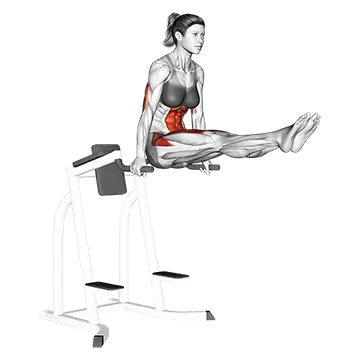
L-Sit on Floor
- Equipamiento
- Body weight
- Parte del cuerpo
- Upper Arms, Waist
- Tipo
- Stretching
The L-Sit on Floor is a demanding bodyweight hold that targets the hip flexors (iliopsoas, tensor fasciae latae), quadriceps, and abdominals (rectus abdominis), while the triceps brachii work isometrically to keep your arms locked and your body elevated. Performed with hands pressed into the floor and legs extended straight out in front, it builds core compression strength and straight-arm pressing endurance simultaneously.
Cómo hacer el L-Sit on Floor
- 1Sit on the floor with your legs extended straight in front of you and your hands placed flat on the floor beside your hips, fingers pointing forward.
- 2Press your hands firmly into the floor, lock your elbows fully, and engage your triceps to create a rigid arm structure.
- 3Brace your core hard and contract your hip flexors to draw your legs up off the ground, aiming for thighs parallel to the floor.
- 4Squeeze your quadriceps to keep your knees straight — bent knees reduce the demand on your hip flexors and core.
- 5Hold the position with your shoulders depressed (pulled away from your ears) and your chest up.
- 6Maintain the hold for the target duration, breathing steadily without letting your hips sag.
- 7Lower your legs back to the floor under control to finish the set.
Consejos de técnica
- Point your toes and actively press your heels away from you — this cues full quad engagement and keeps your legs straight.
- Depress your scapulae (push your shoulders down, not shrugged) before you lift; this protects your shoulder joints and creates a more stable base.
- If you cannot clear the floor, begin with one or both legs bent (tuck L-sit) and work toward the full position as hip flexor strength improves.
- Place your hands on parallettes or raised blocks if floor contact limits wrist extension — it gives your hips room to rise higher.
Errores comunes
- Bending the knees to make the lift easier, which reduces hip flexor and abdominal demand and turns the movement into a weaker variation.
- Shrugging the shoulders toward the ears instead of actively depressing the scapulae, placing excessive stress on the traps and reducing pressing stability.
- Holding the breath throughout the hold, which spikes intra-abdominal pressure unnecessarily — breathe shallowly and consistently instead.
- Letting the hips sag below the hands almost immediately after lifting, which signals a lack of hip flexor strength and should be regressed to a tuck position.
Preguntas frecuentes
What muscles does the L-Sit on Floor work?
It primarily targets the iliopsoas, quadriceps, rectus abdominis, and tensor fasciae latae, with the triceps brachii working isometrically to keep the arms locked and support the body.
Is the L-Sit on Floor suitable for beginners?
It is a challenging movement and not ideal for complete beginners. Build hip flexor and core strength first — leg raises, hollow body holds, and tuck L-sits are good progressions.
How long should I hold an L-Sit?
Start with 3–5 seconds of quality hold and accumulate total time (e.g. 30 seconds per session) across multiple short holds. Work toward a continuous 10–30 second hold as a benchmark.
Why can't I get my legs off the floor?
Weak hip flexors or insufficient triceps strength to support your bodyweight are the most common reasons. Begin with a tuck L-sit (knees bent) or single-leg holds to build the necessary strength.
What is a good alternative to the L-Sit on Floor?
The tuck L-sit, hanging L-sit on a pull-up bar, and parallel bar L-sit are all close alternatives that allow height adjustments or reduced hip flexor demands while training the same core compression pattern.