
Leg Extension Crunch (with Stability Ball)
- Músculo objetivo
- Quadriceps, Rectus Abdominis
- Músculos sinergistas
- Iliopsoas, Obliques, Sartorius
- Equipamiento
- Stability ball
- Parte del cuerpo
- Thighs, Waist
- Tipo
- Strength




The leg extension crunch with a stability ball is a compound core and lower-body exercise that simultaneously targets the quadriceps and rectus abdominis, with supporting work from the iliopsoas, obliques, and sartorius. By combining a spinal flexion crunch with a leg extension on an unstable surface, it challenges balance and coordination while building abdominal strength and quad control. It is well suited for intermediate trainees looking to add functional core training to their routine.
Cómo hacer el Leg Extension Crunch (with Stability Ball)

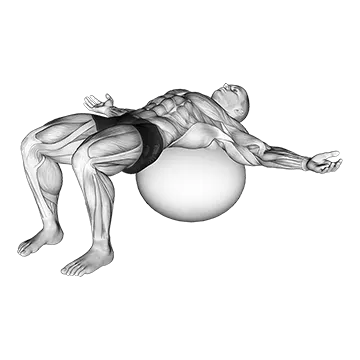
- 1Sit upright on the stability ball with your feet flat on the floor, hip-width apart, and the ball positioned beneath your mid-to-lower back when you recline.
- 2Walk your feet forward and lean back until your lower back and mid-back rest on the ball, with your hips slightly lower than your knees and your head and shoulders unsupported.
- 3Place your hands lightly behind your head or cross them over your chest, keeping your elbows wide.
- 4Engage your core and press your lower back gently into the ball to establish a stable starting position.
- 5Exhale and perform a crunch by lifting your head, neck, and shoulder blades off the ball while simultaneously extending one leg straight out at hip height, pointing your toes forward.
- 6Hold the top position for one count, feeling the contraction in your rectus abdominis and the tension in the extended leg's quadriceps.
- 7Inhale and slowly lower your upper body back onto the ball while bending the knee and returning your foot to the floor in a controlled manner.
- 8Alternate legs with each repetition, or complete all reps on one side before switching, depending on the variation prescribed.
- 9Maintain a neutral neck throughout — avoid pulling on your head — and keep the ball as still as possible to preserve core tension.
Consejos de técnica
- Keep your gaze toward the ceiling rather than tucking your chin to your chest, which reduces strain on the cervical spine and ensures the rectus abdominis does the work.
- Control the ball's movement by actively pressing through your planted foot and bracing your obliques; any rolling or wobbling indicates lost tension.
- Extend the leg fully but avoid locking the knee aggressively — maintain a slight softness to keep quadriceps under continuous load.
- Exhale on the way up and inhale on the way down to synchronize breathing with intra-abdominal pressure and improve crunch depth.
- Start with a larger ball if balance is difficult; a taller ball reduces the range of motion and makes the position easier to stabilize.
Errores comunes
- Pulling the head forward with the hands: this transfers the workload from the rectus abdominis to the neck flexors and risks cervical strain — keep hands light and elbows wide.
- Letting the hips sag toward the floor: dropping the hips shifts the exercise away from the abs and places excessive stress on the lumbar spine — keep hips level with or slightly above knee height.
- Rushing the leg extension: swinging the leg up with momentum rather than controlled quadriceps contraction reduces muscle activation and destabilizes the ball.
- Allowing the stability ball to roll freely: failing to control the ball disrupts body position, shortens the effective range of motion, and reduces engagement of the obliques and iliopsoas.
- Only partially extending the leg: stopping the extension early limits quadriceps recruitment and reduces the anti-rotation demand on the obliques and sartorius that makes the exercise effective.
Preguntas frecuentes
What muscles does the leg extension crunch with a stability ball work?
The primary muscles are the quadriceps and rectus abdominis. The iliopsoas, obliques, and sartorius work as synergists to stabilize the hip and pelvis throughout the movement.
How is this exercise different from a regular crunch?
Adding the stability ball increases the range of spinal flexion available compared to floor crunches, and the simultaneous leg extension recruits the quadriceps and challenges the obliques and iliopsoas to resist rotation and hip dropping.
How many sets and reps should I do?
Two to four sets of 10 to 15 reps per side is a common starting point for core strength. Because the stability ball introduces balance demands, prioritize controlled form over high rep counts.
Is this exercise suitable for beginners?
It requires basic balance on a stability ball and enough core strength to hold the crunch position while moving a limb, so beginners should first become comfortable with standard stability ball crunches and bodyweight leg extensions separately before combining them.
How do I choose the right stability ball size?
When seated on the ball, your hips and knees should both be at approximately 90 degrees. A 55 cm ball suits most people under 5 ft 7 in (170 cm) tall, while a 65 cm ball is appropriate for those between 5 ft 7 in and 6 ft 2 in (188 cm).