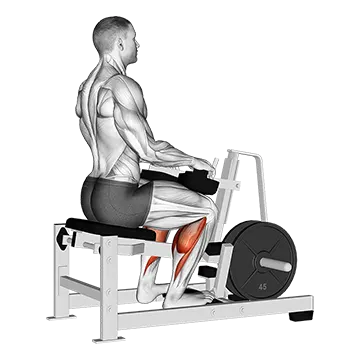
Lever Seated Single Calf Press
- Músculo objetivo
- Gastrocnemius, Soleus
- Equipamiento
- Leverage machine
- Parte del cuerpo
- Calves
- Tipo
- Strength
The lever seated single calf press is a unilateral calf exercise performed on a leverage machine that isolates the gastrocnemius and soleus of one leg at a time. By training each leg independently, it corrects side-to-side strength imbalances and delivers direct, concentrated stimulus to the calf muscles across a full range of motion.
Cómo hacer el Lever Seated Single Calf Press
- 1Sit on the leverage machine seat and place the ball of one foot on the lower edge of the footplate, allowing your heel to hang freely off the edge.
- 2Rest the non-working foot flat on the frame or tuck it out of the way so it provides no assistance during the set.
- 3Position the resistance pad firmly against your lower thigh, just above the knee, and secure it in place.
- 4Sit upright with your spine neutral, core lightly braced, and hands resting on the pad or the machine handles for stability.
- 5Release the safety lever and let your heel drop as far as comfortable to achieve a full, deep stretch of the calf.
- 6Exhale and press the ball of your foot into the footplate, pushing your heel up as high as possible and squeezing the calf hard at the top.
- 7Hold the peak contraction for one count.
- 8Inhale and lower your heel slowly back to the starting stretched position under control.
- 9Complete all reps on the first leg, re-engage the safety lever, then switch feet and repeat.
Consejos de técnica
- Pause for a full second at the bottom of each rep to eliminate bounce and ensure you are working from a true stretch — the gastrocnemius is most loaded in the lengthened position.
- Drive through the big-toe side of the foot rather than the outer edge to keep the calf activation centered and reduce unwanted ankle rotation.
- Keep the working knee angle consistent throughout the set — shifting between a straight and bent knee changes the gastrocnemius-to-soleus ratio mid-set.
- Use a slow, controlled eccentric of two to three seconds on each rep; the soleus and gastrocnemius both respond well to time under tension on the way down.
- Match the load between legs rather than adding weight to the stronger side — the goal of unilateral training is parity, so let the weaker leg dictate the working weight.
Errores comunes
- Bouncing at the bottom of the range of motion, which uses the elastic recoil of the Achilles tendon instead of muscular force and removes the stretch stimulus from the gastrocnemius and soleus.
- Shortening the range of motion by not dropping the heel fully, which prevents the soleus from being fully lengthened and limits the overall growth stimulus of the exercise.
- Allowing the knee to shift position during the set — bending it mid-rep reduces gastrocnemius contribution because that muscle crosses the knee joint, altering which calf muscle is most recruited.
- Using the non-working foot to push against the frame for assistance, which defeats the purpose of unilateral training and masks real strength differences between legs.
- Selecting a load that is too heavy, causing the ankle to roll outward and the movement to become a partial-range grind rather than a controlled full-range press.
Preguntas frecuentes
What muscles does the lever seated single calf press work?
The exercise targets the gastrocnemius and the soleus — the two primary muscles of the calf. The gastrocnemius forms the visible bulk of the calf and is most active when the knee is straight, while the soleus lies beneath it and remains heavily loaded regardless of knee position.
What is the difference between the seated single calf press and the seated calf raise?
Both movements work the calves with the knee bent, emphasizing the soleus alongside the gastrocnemius. The lever machine version uses a footplate and resistance pad to load the movement mechanically, while a traditional seated calf raise uses weight placed across the knees. The single-leg variation on the lever machine adds a unilateral element that corrects strength imbalances that a bilateral setup can mask.
How many sets and reps should I do for the lever seated single calf press?
Calf muscles are highly fatigue-resistant and respond well to moderate-to-high rep ranges. Three to four sets of 12 to 20 repetitions per leg, with a full stretch at the bottom and a deliberate squeeze at the top, is a reliable approach for hypertrophy. Prioritize range of motion and time under tension over heavier loads.
Why should I train calves one leg at a time instead of both together?
Unilateral training exposes and corrects side-to-side strength imbalances that bilateral exercises can hide — the stronger leg tends to compensate for the weaker one when both are loaded together. Training each calf independently also improves neuromuscular focus and allows a greater range of motion without the constraints of a bilateral setup.
Where should I feel the lever seated single calf press?
You should feel the primary contraction in the back of the lower leg — the calf — with the deepest stretch sensation near the Achilles tendon and the heel at the bottom of each rep. If you feel cramping rather than a productive contraction, reduce the load slightly, slow the tempo, and ensure you are pressing through the ball of the foot rather than the outer edge.