
Lying Hip Flexor Stretch
- Músculo objetivo
- Gluteus Maximus
- Equipamiento
- Body weight
- Parte del cuerpo
- Hips
- Tipo
- Stretching
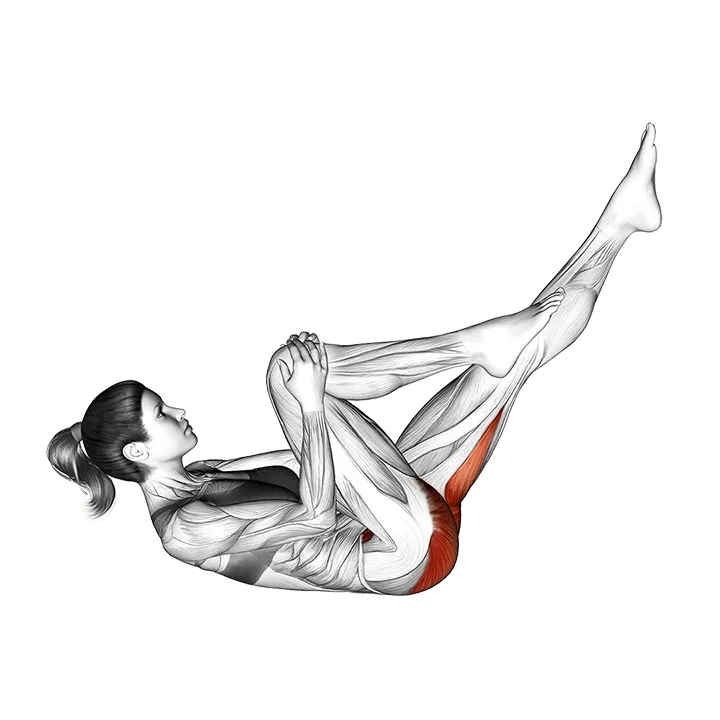
The lying hip flexor stretch is a floor-based bodyweight stretch that targets the gluteus maximus, the large muscle of the buttock. You lie on your back and draw one knee toward the chest while the other leg stays extended, so the spine is supported and no balance is required. It fits well into a cool-down, a mobility session, or any routine aimed at easing tension around the hips and pelvis.
Cómo hacer el Lying Hip Flexor Stretch
- 1Lie flat on your back with your legs extended and your arms resting at your sides.
- 2Draw one knee toward your chest and clasp your hands behind the thigh, just above the back of the knee.
- 3Pull the knee in slowly until you feel a broad stretch across the back of the hip and the gluteus maximus on that side.
- 4Keep the opposite leg fully extended and heavy on the floor — an anchored pelvis keeps the stretch in the hip rather than the lower back.
- 5Keep your head, shoulders, and lower back in contact with the floor, and keep both hips square to the ceiling.
- 6Hold for 20 to 45 seconds, breathing slowly and letting the muscle release with each exhale.
- 7Lower the leg back to the floor under control and repeat on the other side.
- 8Complete 2 to 3 holds per side.
Consejos de técnica
- Aim the knee toward the shoulder on the same side rather than straight up at the ceiling — the extra hip flexion lengthens the gluteus maximus more than a vertical pull does.
- Clasp behind the thigh instead of over the front of the knee; pulling on the kneecap loads the joint rather than the hip.
- If reaching the leg lifts your head off the floor, loop a towel or strap around the back of the thigh so your head and shoulders can stay down.
- Relax your neck, jaw, and shoulders — tension held elsewhere limits how fully the target muscle lets go.
- Ease a little deeper on each exhale and hold the new range, rather than pulling harder on the way in.
Errores comunes
- Letting the hips rotate or tilt to one side during the pull, which shifts tension off the gluteus maximus and onto the lower back.
- Yanking or bouncing the knee toward the chest, which triggers the stretch reflex — the muscle contracts to protect itself and the stretch gets shorter, not longer.
- Letting the extended leg drift up off the floor, which unanchors the pelvis so the hip flexes less and the stretch shrinks.
- Holding the breath, which raises muscular tension and makes it harder for the target muscle to lengthen.
- Cutting the hold short — under 15 seconds does not give the muscle and connective tissue time to relax into a new range.
Preguntas frecuentes
What muscles does the lying hip flexor stretch work?
Despite the name, this floor variation primarily stretches the gluteus maximus — the large muscle of the buttock — because pulling the knee to the chest puts the hip into deep flexion. The name refers to the leg left flat on the floor, whose hip stays extended.
How long should I hold the lying hip flexor stretch?
Hold each side for 20 to 45 seconds. Static holds generally need at least 15 to 30 seconds to produce a meaningful change in range of motion, so anything shorter is mostly wasted. Two to three holds per side per session is a practical starting point.
Is the lying hip flexor stretch good for beginners?
Yes. It needs no equipment, no balance, and keeps your spine supported on the floor, so it is one of the easiest hip stretches to learn. You control the intensity entirely with how hard you pull, which makes it hard to overdo.
Can I do this stretch if I have lower back pain?
Many people with mild lower back tightness find it helpful, since releasing the gluteus maximus reduces pull on the pelvis. If drawing the knee toward the chest increases your pain or causes nerve-like symptoms down the leg, stop and see a healthcare professional before continuing.
When is the best time to do this stretch?
Do it after training, when the muscle is warm, or as part of a dedicated mobility or cool-down routine. Long static holds on cold muscle are less effective and are best avoided immediately before heavy lower-body work, since they can briefly blunt force output.