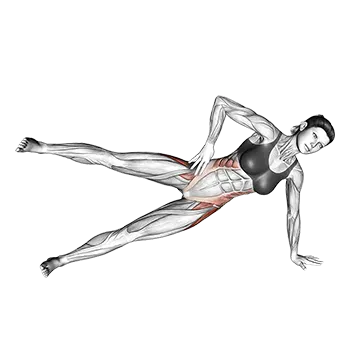
Monster Walk
- Músculo objetivo

- Gluteus Medius, Tensor Fasciae Latae
- Músculos sinergistas

- Soleus
- Equipamiento
- Body weight
- Parte del cuerpo
- Hips
- Tipo
- Aerobic


The Monster Walk is a bodyweight hip exercise that targets the gluteus medius and tensor fasciae latae through lateral stepping patterns that load the hip abductors under continuous tension. The soleus assists in maintaining ankle stability throughout the movement. It is an effective drill for improving hip stability, correcting knee valgus, and warming up the glutes before lower-body training.
Cómo hacer el Monster Walk
- 1Stand with feet hip-width apart and place your hands on your hips or extend them forward for balance.
- 2Adopt a quarter-squat position by pushing your hips back slightly and bending your knees, keeping your chest tall and core braced.
- 3Shift your weight onto your right foot and step your left foot diagonally forward and to the left, landing softly on the ball of your foot.
- 4Follow with your right foot, stepping only far enough to return to a hip-width stance without letting your feet touch, and keep the squat depth as you step.
- 5Continue stepping in the same diagonal direction for the prescribed number of steps or distance.
- 6Reverse the pattern by stepping diagonally backward and to the right, leading with the right foot, to travel back to your starting position.
- 7Finish the set by bringing your feet back to hip-width and standing tall out of the quarter-squat.
Consejos de técnica
- Maintain a consistent squat depth for the entire set — standing up between steps removes the tension on the gluteus medius.
- Keep your toes pointed forward or only slightly outward; excessive toe flare shifts load away from the glutes.
- Drive your knees outward in line with your toes on every step to actively recruit the hip abductors.
- Brace your core and keep your torso upright — leaning heavily to one side is a sign the load or range is too great.
- Use slow, controlled steps rather than rushing; tempo matters more than distance covered.
Errores comunes
- Rising out of the squat between steps: Standing tall between each step eliminates constant tension on the gluteus medius, drastically reducing the training stimulus.
- Allowing knees to cave inward (valgus collapse): Letting the knees drop inward places stress on the ligaments and defeats the purpose of the exercise, which is to strengthen the muscles that prevent this collapse.
- Taking steps that are too wide: Overly wide steps can cause excessive hip sway and shift the demand away from the target muscles, reducing control and increasing injury risk.
- Flaring the toes outward excessively: Significant toe flare externally rotates the hip and transfers load from the gluteus medius to other hip muscles, reducing specificity.
- Rushing through the movement: Performing the walk too quickly sacrifices control and hip stability, turning a strengthening drill into a momentum-based movement.
Preguntas frecuentes
Do I need a resistance band for the Monster Walk?
No — the Monster Walk can be performed with body weight alone, as listed here. A resistance band placed around the ankles or just above the knees is a common progression that increases hip abductor demand, but it is not required to benefit from the movement.
What muscles does the Monster Walk work?
The primary muscles worked are the gluteus medius and tensor fasciae latae, both of which abduct and stabilize the hip during lateral movement. The soleus assists in maintaining ankle stability throughout each step.
Is the Monster Walk good for knee pain?
Strengthening the gluteus medius through exercises like the Monster Walk can help correct knee valgus — the inward collapse of the knee that often underlies patellofemoral pain. However, if you currently have knee pain, consult a healthcare professional before beginning any new exercise.
How many reps or steps should I do for the Monster Walk?
A common starting point is 10–15 steps in each direction for 2–3 sets. As hip stability improves you can increase the number of steps, add a resistance band, or use the walk as a longer warm-up drill covering 10–20 metres.
When should I include the Monster Walk in my workout?
The Monster Walk is most often used as a glute-activation warm-up before squat, deadlift, or running sessions. It can also be programmed as an accessory exercise within a lower-body session to reinforce hip abductor strength and knee tracking.