Standing Hip Abduction
- Músculo objetivo

- Gluteus Medius, Tensor Fasciae Latae
- Equipamiento
- Body weight
- Parte del cuerpo
- Hips
- Tipo
- Strength

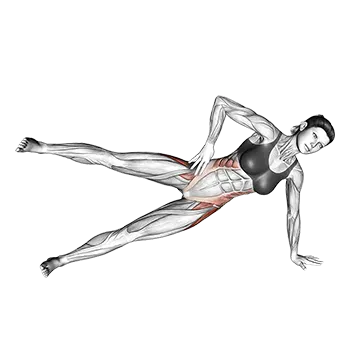


The Standing Hip Abduction is a bodyweight strength exercise that isolates the gluteus medius and tensor fasciae latae by lifting one leg out to the side against gravity while balancing on the other. It directly targets the hip abductors responsible for lateral hip stability and pelvic control during walking, running, and single-leg movements. It is a practical drill for building hip strength, correcting pelvic drop, and rehabilitating the lateral hip.
Cómo hacer el Standing Hip Abduction
- 1Stand tall next to a wall, chair back, or other stable support, placing one hand on it lightly for balance.
- 2Shift your weight onto your standing leg and unlock that knee slightly — do not lock it rigid.
- 3Brace your core gently and keep your pelvis level. Avoid tilting your hips to either side before the movement begins.
- 4Keeping your raised leg straight and your toes pointing forward — not rotated toward the ceiling — lift it out to the side in a smooth arc. Aim to raise it to approximately 30–45 degrees from the midline.
- 5Pause briefly at the top of the movement with the hip fully abducted, maintaining a level pelvis and upright torso.
- 6Lower the leg back to the starting position with control — do not drop it or let it swing.
- 7Complete all reps on one side before switching. Keep the pelvis stable and the torso upright throughout every rep.
Consejos de técnica
- Use the support only as a light balance aid — resting your full weight on the wall or chair reduces the stabilization demand on the standing-leg glute and limits the training benefit.
- Place your free hand on the outside of your working hip so you can feel the gluteus medius contract. The effort should register on the side of the hip, not in your lower back or the front of your thigh.
- Exhale as you lift and inhale as you lower, keeping the core gently braced so the pelvis stays quiet between reps.
- Set your working range by feel, not by height: raise the leg only as far as you can go while the pelvis and torso stay still, and treat that point as the top of the rep.
- Check your form from the front in a mirror, or film a set — a small hip drop or trunk lean is easy to miss by feel and obvious on video.
Errores comunes
- Hiking the pelvis of the standing leg upward — this uses the quadratus lumborum rather than the gluteus medius to lift the leg, reducing hip abductor activation and reinforcing a compensation pattern that contributes to gait dysfunction. Keep the pelvis level as if balancing a tray of water on it.
- Externally rotating the working leg so the toes point toward the ceiling — this shifts the primary load from the gluteus medius to the hip flexors and reduces the lateral hip challenge. Maintain forward-facing toes throughout the arc.
- Leaning the torso away from the working leg — side-bending the trunk is a compensation that makes the movement feel easier without training the hip abductors properly. An upright torso is required for genuine gluteus medius loading.
- Using momentum to swing the leg rather than lifting it with controlled muscle contraction — swinging reduces time under tension and trains balance instead of hip abductor strength. Lift and lower deliberately on every rep.
- Going through too large a range of motion — lifting the leg beyond 45 degrees typically makes the pelvis hike or the torso lean away, turning the rep into trunk side-bending instead of hip abduction. Stop where the pelvis stays level and reduce the range if needed.
Preguntas frecuentes
What muscles does the standing hip abduction work?
The standing hip abduction primarily targets the gluteus medius and tensor fasciae latae. These muscles sit on the lateral hip and are responsible for moving the leg away from the midline of the body and stabilizing the pelvis when you stand on one leg. No significant synergist muscles are recruited in the standard bodyweight version of the exercise.
How is the standing hip abduction different from the side-lying hip abduction?
Both exercises target the same primary muscles — the gluteus medius and tensor fasciae latae — but the standing version adds a balance and stabilization demand on the supporting leg. The side-lying version removes gravity from the hip-stabilization equation, making it easier to isolate the abductors without compensation. The standing version is more functional and transfers better to walking, running, and single-leg activities, while the side-lying version is useful in early rehabilitation or when balance is a limiting factor.
Can standing hip abductions help with knee pain?
Weak hip abductors — particularly the gluteus medius — are associated with inward knee collapse (valgus) during walking and running, which is a common contributor to patellofemoral pain and IT band issues. Strengthening the gluteus medius with exercises like standing hip abductions can improve pelvic and hip stability, which reduces the inward rotation that stresses the knee. However, knee pain should be assessed by a clinician before beginning a rehabilitation program, as not all knee pain has the same cause.
How many reps and sets should I do for standing hip abductions?
For general strength and stability, 2–3 sets of 12–20 repetitions per side is a practical starting range. Because the gluteus medius is a stabilizing muscle that responds well to higher repetitions and time under tension, working in the 15–20 rep range with controlled tempo tends to be more effective than low-rep heavy loading.
How do I make the standing hip abduction harder when bodyweight is too easy?
Slow the tempo first — a two-count lift, a pause at the top, and a two-count lower makes each rep noticeably harder with no equipment. From there, let go of the support so the standing leg has to stabilize you on its own, and add reps per set. All three progressions keep the work on the gluteus medius and tensor fasciae latae rather than shifting it elsewhere.