

Resistance Band Half Kneeling Face Pull
- Músculo objetivo
- Deltoid Posterior
- Músculos sinergistas
- Brachialis, Brachioradialis, Infraspinatus, Teres Minor, Trapezius Middle Fibers
- Equipamiento
- Resistance Band
- Parte del cuerpo
- Shoulders
- Tipo
- Strength
The resistance band half kneeling face pull targets the posterior deltoid while engaging the infraspinatus, teres minor, middle trapezius, brachialis, and brachioradialis as synergists. The half-kneeling position reduces lower-body compensation and forces your core to stabilize the movement. It is especially useful for building rear-shoulder strength and improving shoulder health and posture.
Cómo hacer el Resistance Band Half Kneeling Face Pull
- 1Anchor a resistance band at approximately face height to a stable post or door anchor.
- 2Kneel on your left knee with your right foot forward, forming a 90-degree angle at both knees — this is the half-kneeling position.
- 3Face the anchor point and grasp one end of the band in each hand using an overhand grip, arms extended in front of you.
- 4Brace your core and squeeze your glutes to stabilize your hips and pelvis.
- 5Pull the band toward your face, driving your elbows back and out to the sides until your hands reach ear level.
- 6At the end of the pull, externally rotate your shoulders so your palms face forward and your elbows point behind you.
- 7Pause for one second at the peak contraction, feeling the squeeze in your rear deltoids and middle traps.
- 8Slowly extend your arms back to the start position under control, resisting the band's pull.
- 9Complete all reps on one side, then switch legs and repeat.
Consejos de técnica
- Keep your torso upright throughout — avoid leaning back to gain momentum, as this shifts stress away from the rear deltoids.
- Lead the pull with your elbows, not your hands, to maximize posterior deltoid and infraspinatus activation.
- Squeeze your shoulder blades together at the end of each rep to fully engage the middle trapezius fibers.
- Control the return phase — a slow, 2-to-3-second eccentric extends time under tension and reduces injury risk.
- Choose a band tension that lets you complete all reps with full range of motion without your elbows dropping below shoulder height.
Errores comunes
- Using too much band resistance and relying on momentum: swinging the torso to complete the pull reduces rear-deltoid engagement and increases stress on the lower back.
- Letting the elbows drop below shoulder height during the pull: this shifts the load away from the posterior deltoid and onto the biceps.
- Skipping the external rotation at the end of the movement: omitting this step limits infraspinatus and teres minor activation, which are key for shoulder joint stability.
- Allowing the hips to rotate or shift during the pull: the half-kneeling position demands a stable pelvis — lateral hip movement signals the band is too heavy or the core is not properly braced.
- Rushing through reps: fast, uncontrolled repetitions reduce time under tension and make it harder to maintain the elbow-above-wrist path that the exercise requires.
Preguntas frecuentes
Why do this exercise in the half-kneeling position instead of standing?
The half-kneeling position eliminates lower-body momentum, so you cannot use your legs or hips to help pull the band. It also challenges your core to resist lateral flexion, making the movement more targeted and correcting side-to-side imbalances.
How many sets and reps should I do for the resistance band half kneeling face pull?
Two to four sets of 12 to 20 reps works well for most goals. Higher rep ranges suit the rear deltoids and rotator cuff muscles, which respond well to moderate loads and controlled volume.
Where should I anchor the resistance band?
Anchor the band at roughly face height when you are in the kneeling position. An anchor point that is too high or too low changes the pull angle and shifts the load away from the posterior deltoid.
Can this exercise help with shoulder pain or posture problems?
Strengthening the posterior deltoid, infraspinatus, teres minor, and middle trapezius can counterbalance the forward shoulder posture that comes from excessive pressing or desk work. Always clear any existing shoulder pain with a qualified professional before adding new exercises.
How do I know when to use a heavier resistance band?
Progress to a heavier band when you can complete all sets and reps with full range of motion, proper external rotation at the peak, and no torso lean — without the band feeling like it is pulling you forward out of the kneeling position.
Ejercicios relacionados
 Resistance Band Pull ApartShoulders
 Resistance Band Pull Apart (45 degrees)Shoulders
 Resistance Band Rear FlyShoulders
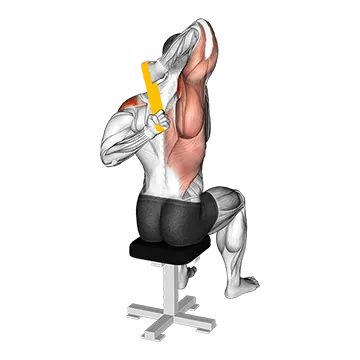 Resistance Band Shoulder Stretch Behind the BackShoulders
 Band Face PullShoulders
 Band horizontal Pallof Press with Resistance Band SquatHips, Thighs, Waist
 Band rear delt rowShoulders
 Band reverse flyShoulders