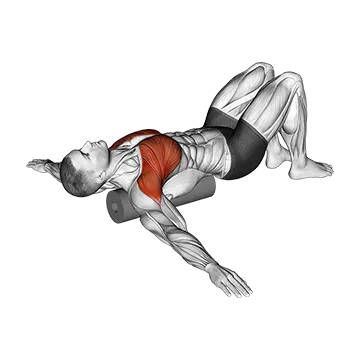
Roll Biceps Lying on Floor
- Músculo objetivo
- —
- Equipamiento
- Roll
- Parte del cuerpo
- Upper Arms
- Tipo
- Stretching

Roll Biceps Lying on Floor is a self-myofascial release exercise that targets the biceps brachii using a foam roller. Performed face-down on the floor with the roller positioned under one upper arm, it releases muscular tension, improves tissue quality, and reduces post-workout soreness in the front of the upper arm.
Cómo hacer el Roll Biceps Lying on Floor
- 1Place a foam roller on the floor and lie face-down with your body fully extended.
- 2Position the roller under one upper arm, just below the shoulder, with your palm facing the floor.
- 3Extend the working arm out to the side at roughly a 45–90° angle from your torso so the biceps rests directly on top of the roller.
- 4Support your body weight on your opposite forearm and the toes of both feet.
- 5Slowly roll the foam roller down your upper arm from just below the shoulder toward the crease of the elbow, using gentle pressure.
- 6Pause for 2–3 seconds on any tight or tender spot, maintaining steady pressure without forcing through sharp pain.
- 7Continue rolling back up toward the shoulder, working the full length of the biceps brachii.
- 8Complete 30–60 seconds on one arm, then switch to the other side.
Consejos de técnica
- Use your supporting forearm and toes to control how much body weight presses into the roller — less weight means less pressure, which is useful on very sore tissue.
- Rotate your forearm slightly inward and outward as you roll to expose different fibers of the biceps and surrounding tissue.
- Breathe slowly and steadily throughout; exhaling as you hit a tender spot helps your nervous system relax into the pressure.
- Move no faster than one inch per second — slow, deliberate strokes are far more effective than quick passes.
- Keep your neck neutral and your gaze toward the floor rather than craning your head up, which reduces unnecessary strain on the cervical spine.
Errores comunes
- Rolling too fast over the muscle, which does not give the tissue enough time to release and reduces the effectiveness of the technique.
- Placing the roller directly on the elbow joint, which stresses the joint itself rather than the muscle and can cause discomfort or injury.
- Allowing the shoulder to shrug or roll inward during the exercise, which shifts pressure away from the biceps and onto the shoulder joint.
- Applying excessive body weight on a very inflamed or acutely injured area, which can aggravate the tissue rather than promote recovery.
- Holding your breath through painful spots, which increases muscle guarding and prevents the myofascial release you are trying to achieve.
Preguntas frecuentes
What muscles does Roll Biceps Lying on Floor work?
The exercise targets the biceps brachii, the primary muscle on the front of the upper arm. The surrounding connective tissue and the underlying brachialis may also benefit from the pressure.
When should I do foam rolling for the biceps — before or after a workout?
Both are useful. Rolling before a session can improve tissue mobility and range of motion. Rolling after a session helps clear metabolic waste, reduce delayed-onset muscle soreness, and speed recovery.
How much pressure should I use on the foam roller?
Use enough pressure to feel moderate discomfort — often described as a 'good hurt' — but never sharp or shooting pain. Lower your body weight through your support arm to fine-tune the intensity.
How long should I spend foam rolling each bicep?
Aim for 30–60 seconds per arm per session. Spending longer on a specific tender spot, around 20–30 seconds of sustained pressure, can help it release more fully.
Can I use a lacrosse ball instead of a foam roller for this exercise?
Yes. A lacrosse ball delivers more targeted, concentrated pressure and is useful for working into smaller or harder-to-reach areas of the biceps. The technique is essentially the same, though you will need to move more slowly and carefully.