
Seated Ballerina
- Músculo objetivo
- —
- Equipamiento
- Stability ball
- Parte del cuerpo
- Shoulders
- Tipo
- Strength


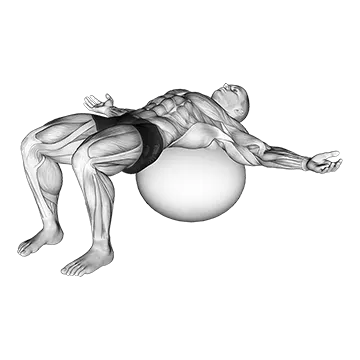

Seated Ballerina is a shoulder stability and strength exercise performed upright on a stability ball, using controlled arm raises and lateral sweeps that mirror a ballerina's port de bras. The unstable surface forces the deltoids and rotator-cuff stabilizers to work harder while simultaneously demanding core engagement to maintain an upright posture. It is an excellent choice for developing shoulder endurance, postural control, and balance simultaneously.
Cómo hacer el Seated Ballerina
- 1Place a stability ball on a flat, non-slip surface and sit centered on top of it with your feet flat on the floor, roughly hip-width apart.
- 2Sit tall, stacking your hips beneath your shoulders and lifting the crown of your head toward the ceiling; avoid rounding the lower back or leaning to either side.
- 3Brace your core lightly — imagine drawing your navel gently inward — to stabilize your pelvis on the ball.
- 4Let your arms hang naturally at your sides with a slight bend in the elbows and your palms facing your body.
- 5Inhale to prepare, then exhale as you slowly raise both arms out to the sides in a wide arc, like a ballerina opening her arms, until they reach approximately shoulder height.
- 6Hold the raised position for one to two seconds, keeping your shoulders pulled down away from your ears and your wrists relaxed.
- 7Inhale as you lower your arms with control back to the starting position, resisting gravity rather than letting them drop.
- 8Repeat for the desired number of reps, maintaining a steady upright posture and stable ball throughout every repetition.
Consejos de técnica
- Keep your feet firmly planted and slightly wider than hip-width if you feel unsteady — a wider base makes the ball easier to control while you learn the movement.
- Focus on moving from the shoulder joint, not the wrists or elbows; imagine your arms floating up like a ballerina rather than being muscled into position.
- Keep your shoulders actively depressed (pulled away from your ears) throughout the lift to engage the lower trapezius and protect the shoulder joint.
- Use a slow, deliberate tempo — two counts up, one count hold, two counts down — to maximize shoulder-stabilizer activation and reduce momentum.
- If the ball shifts or you struggle to stay upright, reduce the range of the arm raise or lighten any added load before progressing.
Errores comunes
- Shrugging the shoulders up toward the ears during the raise, which overloads the upper trapezius and reduces deltoid engagement — keep the shoulders packed down throughout the movement.
- Leaning the torso back or arching the lower back as the arms rise, which shifts load off the shoulders and compresses the lumbar spine — maintain a tall, neutral spine for the duration.
- Using momentum to swing the arms up rather than lifting with control, which reduces time under tension for the stabilizers and undermines the balance challenge the stability ball provides.
- Letting the knees drift inward or the feet leave the floor, which destabilizes the ball and makes the shoulder movement unsafe — keep feet flat and knees tracking over the toes.
- Raising the arms above shoulder height on each rep, which can cause the shoulder to impinge or the torso to compensate — stop at shoulder level for safe, effective shoulder loading.
Preguntas frecuentes
What muscles does the Seated Ballerina work?
The primary muscles worked are the deltoids (particularly the medial and anterior heads) and the rotator-cuff stabilizers. The core musculature — including the transverse abdominis and erector spinae — is also engaged continuously to maintain balance on the stability ball.
Do I need any special equipment besides the stability ball?
No. The Seated Ballerina uses the stability ball as the only piece of equipment. You can perform it with just your bodyweight, and the instability of the ball provides the resistance and balance challenge.
Is the Seated Ballerina suitable for beginners?
Yes, with caution. Beginners should start with a properly inflated, appropriately sized stability ball and practice sitting stably before adding the arm movement. Placing the ball against a wall initially can help build confidence.
How does sitting on a stability ball make the exercise harder?
The unstable surface of the stability ball constantly challenges your core and hip stabilizers to keep you upright. This increases shoulder-stabilizer activation compared to performing the same arm movement seated on a bench.
How many sets and reps should I do?
For shoulder stability and endurance, 2–4 sets of 12–20 controlled reps works well for most people. Prioritize smooth form and a steady balance point over adding volume too quickly.