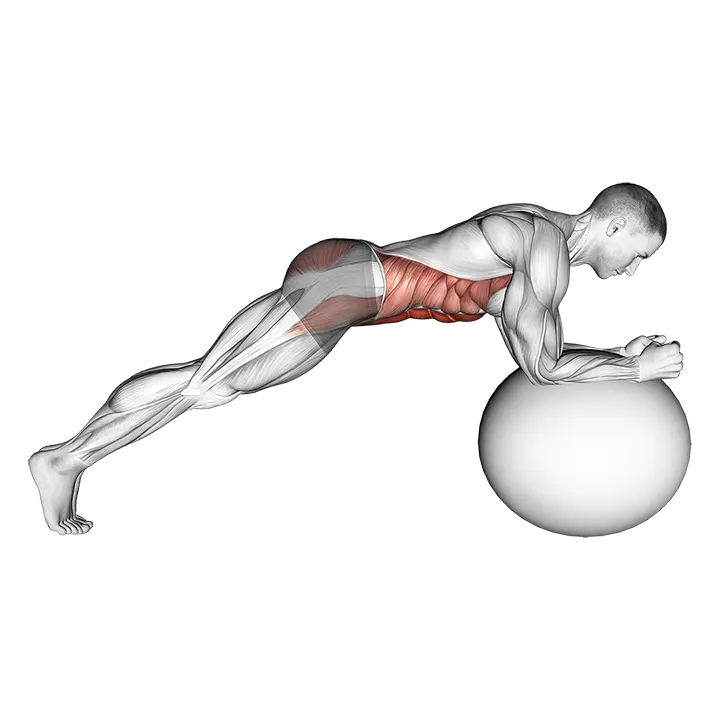
Stability Ball Front Plank
- Músculo objetivo
- —
- Equipamiento
- Stability ball
- Parte del cuerpo
- Waist
- Tipo
- Strength
The Stability Ball Front Plank is a core-strengthening exercise that places your forearms on a stability ball instead of the floor, turning a standard plank into a dynamic anti-sway challenge for the waist and deep stabilizers. The unstable surface forces the rectus abdominis and surrounding core muscles to work continuously to resist rotation and collapse. It is ideal for building core endurance, improving balance, and progressing beyond the traditional floor plank.
Cómo hacer el Stability Ball Front Plank
- 1Place a stability ball on the floor and kneel behind it. Rest both forearms on the top of the ball with your elbows roughly shoulder-width apart and your hands loosely clasped or flat.
- 2Step your feet back one at a time until your body forms a straight line from your head to your heels, supporting yourself on your forearms and toes.
- 3Brace your core as if you are about to absorb a punch — draw your navel slightly in without holding your breath.
- 4Squeeze your glutes and keep your hips level, neither sagging toward the floor nor piking upward toward the ceiling.
- 5Keep your head in a neutral position — eyes looking slightly ahead of the ball so your neck stays in line with your spine.
- 6Hold this position while breathing steadily, maintaining full-body tension throughout the hold.
- 7To finish, lower one knee to the floor at a time rather than collapsing forward onto the ball.
Consejos de técnica
- Press your forearms gently into the ball — actively pushing down helps stabilize the ball and increases muscle activation in your core.
- Narrow your feet slightly to increase the anti-rotation challenge, or widen them for extra stability when learning the movement.
- Focus on keeping the ball still rather than simply holding the position — stillness is the cue that tells you your core is truly engaged.
- Set a timer rather than counting — it reduces mental distraction and lets you focus entirely on body position.
Errores comunes
- Letting the hips sag toward the floor, which reduces core tension and compresses the lower back — keep the body in a strict straight line.
- Piking the hips up to make the hold easier, which shifts the workload away from the core and turns the exercise into a rest position.
- Holding your breath throughout the hold, which raises blood pressure unnecessarily — maintain slow, rhythmic breathing while staying braced.
- Placing the elbows too far forward on the ball, which reduces stability and makes it nearly impossible to maintain a neutral spine.
- Rushing the setup by jumping both feet back at once, which causes the ball to roll and increases the risk of losing control — step one foot back at a time.
Preguntas frecuentes
What muscles does the Stability Ball Front Plank work?
It primarily targets the core and waist — including the rectus abdominis and deep stabilizing muscles — which must work harder than in a floor plank to resist the continuous small movements of the ball. The glutes and shoulders also engage to maintain the straight-body position.
Is the Stability Ball Front Plank harder than a regular floor plank?
Yes. The unstable surface of the ball removes the rigid support of the floor, forcing your core to make constant micro-adjustments to keep the ball from rolling. Most people find it noticeably more demanding even at short hold durations.
How long should I hold the Stability Ball Front Plank?
Beginners can aim for 10–20 second holds and build up gradually. Intermediate and advanced exercisers typically target 30–60 second holds. Quality of position matters more than duration — stop the set the moment form breaks down.
What size stability ball should I use?
A standard 55 cm ball works for most people of average height. If you are taller (over 6 ft / 183 cm), a 65 cm ball keeps your body angle more favorable. The ball should be fully inflated so it offers firm resistance rather than collapsing under load.
Can beginners do this exercise?
Yes, with appropriate progression. Start by mastering the standard floor forearm plank first, then introduce the ball. You can also begin with your knees on the floor and the forearms on the ball to reduce the load before attempting the full straight-body version.