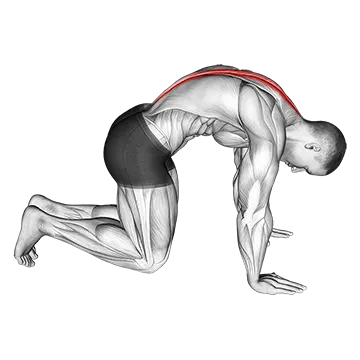
Standing Pelvic Tilt
- Músculo objetivo
- Erector Spinae
- Equipamiento
- Body weight
- Parte del cuerpo
- Back
- Tipo
- Stretching
The standing pelvic tilt is a bodyweight stretching exercise that targets the erector spinae and gently mobilizes the lower back. By rocking the pelvis forward and backward while standing, it releases tension along the spine and improves lumbar mobility. It is an ideal warm-up movement or cool-down stretch for anyone experiencing lower-back stiffness.
Cómo hacer el Standing Pelvic Tilt
- 1Stand with your feet hip-width apart, knees soft and slightly bent, arms relaxed at your sides.
- 2Find a neutral spine — your lower back should have a gentle inward curve, your pelvis level.
- 3Inhale to prepare, then on your exhale tighten your abdominals and tuck your pelvis under by flattening your lower back against an imaginary wall behind you.
- 4Hold this posterior tilt for 2–3 seconds, feeling a mild stretch through your lower back.
- 5Slowly release and allow your pelvis to tip forward into a gentle anterior tilt, letting a slight arch return to your lower back.
- 6Hold the anterior tilt for 2–3 seconds, then return to neutral.
- 7Continue the movement in a smooth, controlled rocking rhythm for the desired number of repetitions.
Consejos de técnica
- Keep the movement small and deliberate — the range of motion is only a few degrees in each direction, not a full squat or back bend.
- Breathe rhythmically: exhale as you tuck the pelvis under, inhale as you release forward.
- If the tilt is hard to feel, stand with your back against a wall — pressing your lower back into the wall teaches the posterior tilt, and letting a small gap open teaches the anterior tilt.
- Stand tall and avoid letting your upper body collapse forward or your shoulders round during the movement.
Errores comunes
- Moving the whole torso instead of isolating the pelvis, which reduces the targeted stretch on the erector spinae and turns the movement into a sway.
- Holding your breath during the tuck, which increases spinal tension rather than releasing it.
- Locking the knees straight, which limits pelvic mobility and reduces the effectiveness of the stretch.
- Rushing through the repetitions without pausing at each end position, which prevents the erector spinae from fully releasing tension.
Preguntas frecuentes
What muscles does the standing pelvic tilt stretch?
The standing pelvic tilt primarily stretches the erector spinae — the group of muscles that run along either side of the spine — helping to relieve tension and stiffness in the lower back.
How many reps should I do for the standing pelvic tilt?
Start with 10–15 slow, controlled repetitions. Focus on quality of movement and holding each end position briefly rather than rushing through a high rep count.
Can I do the standing pelvic tilt if I have lower back pain?
Gentle pelvic tilts are commonly recommended for mild lower-back discomfort. However, if you have a diagnosed spinal condition or sharp pain, consult a healthcare professional before adding this or any movement to your routine.
When is the best time to do the standing pelvic tilt?
It works well as a dynamic warm-up before training to wake up the lower back, or as a cool-down stretch afterward to release built-up tension. It can also be done throughout the day if you sit for extended periods.
Is the standing pelvic tilt the same as a hip tilt?
Yes — the terms are often used interchangeably. Both describe the same movement of rocking the pelvis forward (anterior tilt) and backward (posterior tilt) while keeping the rest of the body relatively still.