Suspension Front Plank
- Músculo objetivo
- Rectus Abdominis
- Músculos sinergistas
- Obliques, Quadriceps, Tensor Fasciae Latae
- Equipamiento
- Suspension
- Parte del cuerpo
- Waist
- Tipo
- Strength

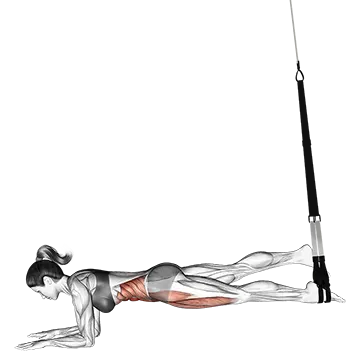
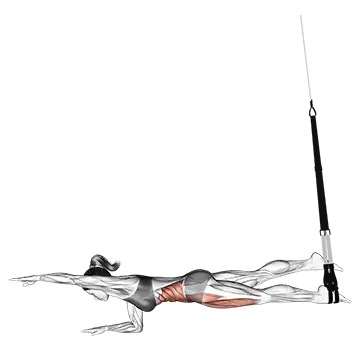


The suspension front plank is a core strength exercise that primarily targets the rectus abdominis, with significant support from the obliques, quadriceps, and tensor fasciae latae. Your feet are secured in suspension straps while your hands remain on the floor in a standard plank position, making the exercise considerably harder than a floor plank because the unstable straps force your core to work continuously to resist movement. It is an effective way to build anterior core strength and stability without any additional load.
Cómo hacer el Suspension Front Plank
- 1Set the suspension straps so the foot cradles hang roughly 6–12 inches off the floor.
- 2Kneel in front of the anchor point, place your feet through the foot cradles with the tops of your feet facing down, then lower yourself onto your hands.
- 3Walk your hands forward until your body forms a straight line from head to heels, with your wrists directly under your shoulders.
- 4Squeeze your glutes, brace your core, and press the floor away with your hands to keep your spine neutral.
- 5Hold this position for the prescribed duration, keeping your hips level — do not let them sag toward the floor or pike up toward the ceiling.
- 6Breathe steadily throughout the hold, exhaling slowly without releasing the abdominal brace.
- 7To finish, carefully walk your hands back toward the straps, lower your knees to the floor, and step your feet out of the cradles.
Consejos de técnica
- Maintain a neutral spine throughout — think of making your body as rigid as a plank of wood from ears to heels.
- Keep your gaze at a spot on the floor a few inches in front of your hands to avoid craning your neck up or tucking your chin too far.
- Actively push the floor away with your hands rather than just resting on them; this engages your shoulders and increases core demand.
- If the straps swing or rotate, slow your breathing and tighten your brace rather than trying to fight the movement with your hips.
Errores comunes
- Letting the hips sag toward the floor, which shifts stress away from the core and loads the lower back instead.
- Piking the hips up toward the ceiling, which reduces core activation and turns the exercise into something closer to a pike hold.
- Holding your breath during the hold, which spikes intra-abdominal pressure and causes you to fatigue much faster than necessary.
- Placing the hands too far in front of the shoulders, which overloads the wrists and reduces stability through the whole chain.
- Starting with the straps set too high, which increases the lever arm dramatically and makes the position unsafe for beginners — keep the cradles close to the floor.
Preguntas frecuentes
What muscles does the suspension front plank work?
The primary target is the rectus abdominis. The obliques, quadriceps, and tensor fasciae latae all work as synergists to keep your body rigid and your hips level.
How is the suspension front plank different from a regular floor plank?
In a floor plank your feet have a fixed, stable base. When your feet are in suspension straps the unstable surface forces your core and stabilizers to work much harder to prevent unwanted movement, increasing the muscular demand significantly.
How long should I hold the suspension front plank?
Start with holds of 15–20 seconds and build toward 45–60 seconds as your core strength improves. Quality of position matters more than duration — stop the set the moment your hips drop or pike.
How do I make the suspension front plank easier or harder?
Raising the foot cradles higher off the floor makes it harder, because more of your bodyweight shifts onto your hands and your core has to resist more; setting the cradles lower makes it easier. Beginners can also start with a regular floor plank and add the straps once they can hold a solid plank for 45–60 seconds.